Global cat losses top $100B for 6th consecutive year despite ‘uncharacteristic’ lack of major events in Q3

Anita Byer

A recent report on global natural catastrophe losses revealed that despite an uncharacteristic lack of major events during the third quarter of 2025, insured losses still managed to top $100 billion globally for the sixth consecutive calendar year and the eighth year since 2017. Gallagher Re’s 2025 Natural Catastrophe and Climate Report (Q3) found that governments and insurers are currently well within their annual catastrophe budgets due to the “abnormally low frequency of high-cost events” to date. Gallagher Re, however, cautions that the trend of greater losses over time is likely to persist as volatility and the likelihood of greater loss potential continue to increase.

Despite losses already topping $100 billion, the data set forth in the report reveals below-average economic and insured losses during the first nine months of 2025. According to Gallagher Re’s preliminary loss data,

  • Global economic loss estimates from all natural perils during the first three quarters of 2025 is $214 billion. In addition to being the lowest total since 2015, this loss estimate is substantially less than the 2015-2024 Q1-Q3 average of $338 billion.
  • Global insured loss estimates during the first three quarters of 2025 total $105 billion, which is the lowest total since 2019. It is also substantially less than the 2015-2024 Q1-Q3 average of $114 billion.
  • The unusual lack of major events from July through September made it one of the least expensive third quarters for insurance companies since 2000.
  • Insured losses during the third quarter alone are estimated to be less than $15 billion, which is the lowest total since 2016.
  • Economic losses during the third quarter alone are estimated to be less than $50 billion, which is the lowest Q3 loss estimate since 2006.


The report notes that the financial health of property insurers will strengthen further if these unusually low losses persist for the remainder of 2025. Gallagher Re estimates that it would require unexpected catastrophic events resulting in insured losses of at least $115 billion to meaningfully impact the insurance industry, but the year is not over yet.

While the fourth quarter is typically the least expensive quarter for economic and insured losses, it seems nobody to Hurricane Mellissa, which tied long-standing Atlantic Basin records for lowest recorded pressure (892 millibars) and peak sustained winds (185 mph) when it made landfall in late October. According to Verisk, a data analytics firm, insured property losses for Hurricane Melissa are expected to range between $2.2 and $4.2 billion. Fortunately, these loss estimates are well below Gallagher Re’s estimated loss cushion retained by insurers due to the uncharacteristic lack of major events during the third quarter of 2025.

Contact our team of experienced and responsive insurance and risk management professionals to find affordable options to protect your home and your business against natural disasters and other catastrophes.
Understanding your specific risks is key to hurricane preparedness

By Anita Byer

The 2025 hurricane season is underway, so the time to prepare is now. We know that preparing for hurricane season can be overwhelming, particularly when the forecast is for above-normal storm activity. Fortunately, preparations can be made easier by working smarter, not harder. In this context, working smarter means understanding the types of wind and water hazards you may face in the event of a storm.

According to the National Oceanic and Atmospheric Administration, the primary hazards from tropical cyclones (tropical depressions, tropical storms, hurricanes) include storm surge flooding, inland flooding from heavy rains, and destructive winds. To effectively prepare for hurricane season, it is important to consider your specific threats.

Storm surge, which is water that is pushed toward shore by storm winds, has historically caused the largest loss of life in hurricanes. This rise in water level can cause severe flooding in coastal areas, which can submerge entire areas, cause structural damage to buildings, and wash out roads. Storm surge can travel several miles inland, especially along bays, rivers, and estuaries.

Flooding, including flash flooding from extreme rainfall, has also proven to be very damaging and deadly. Homes and businesses could flood. Washed out roads can make evacuations difficult, if not impossible, and potentially deadly for those caught in their vehicles. Extreme rain from storms and hurricanes often flood areas that aren’t normally prone to flooding, including hundreds of miles inland.

Hurricane-force winds can cause damage to homes and other buildings, ranging from moderate to catastrophic depending on both wind speed and structural integrity. These winds can cause power and communications outages. Uprooted trees and debris can make roads impassable. Signs, roofing material, and other items left outside can become flying missiles during hurricanes.

To properly understand your risk, NOAA recommends taking the following steps.

Determine if you live in a flood-prone area. Anyone living in a flood-prone area is especially vulnerable to hurricane impacts. However, floods are not limited to flood zones. Extreme rain from tropical storms and hurricanes can bring floods to areas that are not prone to flooding. To properly protect against flooding, it is crucial to fully understand the specific flood risk in your area.

Identify your home’s structural risks. Find out if your home has any weaknesses that may not be able to withstand excessive wind, rain, or flooding. Are your exterior doors, windows, and garage door hurricane proof? Do you have storm shutters? Some aspects of your home can be strengthened to help withstand hurricane impacts (and possibly reduce insurance premiums). Items that cannot be strengthened permanently may need to be reinforced temporarily in the event of a storm.

Find out if you live in an evacuation zone. Determine if you live in an evacuation zone. In addition to providing insight into your specific vulnerability to storm winds, rain, and surge, it will also let you know whether you must have plans in place to evacuate your family long before the evacuation order is given.

Get an insurance check-up. NOAA stresses the importance of insurance, particularly during hurricane season. Make sure you have enough insurance to repair or replace your home, car, personal property, and business. Remember, standard policies do not cover flooding, so you will need a separate flood insurance policy for your home and business.

It only takes one storm to make it an active hurricane season for you. Start preparing before the lines grow long and supplies run short. Contact our team of experienced and responsive insurance and risk management professionals to find affordable options to protect your home and your business in the event of a hurricane.

NOAA is forecasting more named storms and hurricanes in 2024 than ever before

By Anita Byer, Setnor Byer Insurance & Risk

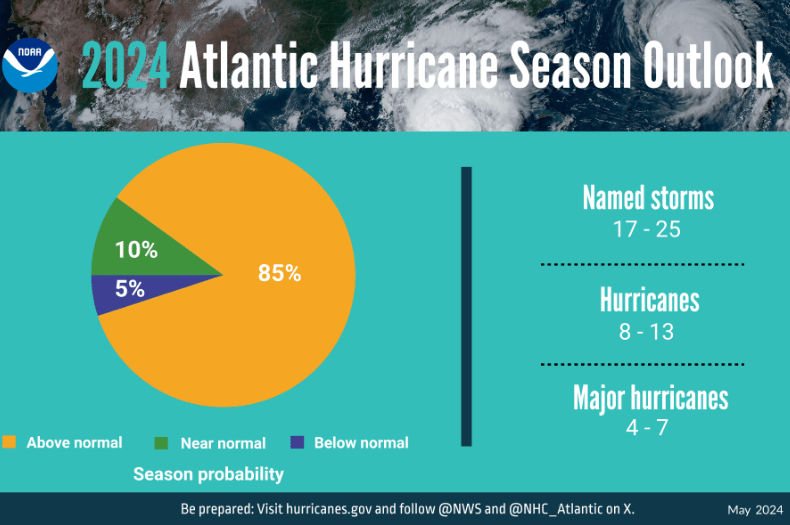
The National Oceanic and Atmospheric Administration is expecting above-normal hurricane activity during the 2024 Atlantic hurricane season. NOAA forecasters are predicting an 85 percent chance of an above-normal season, a 10 percent chance of a near-normal season and a 5 percent chance of a below-normal season. According to NOAA Administrator Dr. Rick Spinrad, “[t]his season is looking to be an extraordinary one in a number of ways…Of note, the forecast for named storms, hurricanes and major hurricanes is the highest NOAA has ever issued for the May outlook.” The Atlantic hurricane season runs from June 1 to November 30.

This year, NOAA is forecasting (with 70 percent confidence) a likely range of:

  • 17 – 25 Named Storms (winds of 39 mph or higher)
  • 8 – 13 Hurricanes (winds of 74 mph or higher)
  • 4 – 7 Major Hurricanes (winds of 111 mph or higher)

Like the forecast team at Colorado State University, NOAA identifies various factors in support of its above-normal forecast. According to NOAA, above-normal activity is expected due to a confluence of factors, including near-record warm ocean temperatures in the Atlantic Ocean, development of La Nina conditions in the Pacific, reduced Atlantic trade winds and less wind shear, all of which tend to favor tropical storm formation.

As one of the strongest El Ninos ever observed nears its end, NOAA scientists predict a quick transition to La Nina conditions, which lessen disruptive wind shear in the tropics. Abundant ocean heat also creates more energy to fuel storm development. An above-normal west African monsoon can produce African easterly waves that seed some of the strongest and longer-lived Atlantic storms. Finally, NOAA identifies light trade winds, which minimize ocean cooling and allow hurricanes to strengthen without the disruption of strong wind shear.

NOAA’s 2024 Atlantic Hurricane Season Outlook reminds us that individuals, businesses and communities must prepare now for the upcoming season. Remember, it only takes one storm to make it an active hurricane season for you. Please contact us to discuss affordable insurance options to protect your personal and business property during the 2024 hurricane season.

Broward County’s new flood zone maps will require thousands to purchase new flood insurance policies beginning July 31, 2024

By Anita Byer, Setnor Byer Insurance & Risk

The Federal Emergency Management Agency recently finalized Broward County’s new Flood Insurance Rate Maps (FIRMs). According to the City of Ft. Lauderdale’s Flood Plain Manager, Broward County’s new FIRM will expand the Special Flood Hazard Area by 15 percent. This is significant because home and business owners with mortgages from federally regulated or insured lenders are required to carry flood insurance if their property is located within a SFHA. Preliminary reports indicate that nearly one hundred thousand additional property owners will be required to carry flood insurance when Broward County’s new flood maps become effective July 31, 2024. Does that include you?

Flood zone maps are used to determine a property’s flood risk. Any place with a one percent (or higher) chance of experiencing a flood each year is considered to have a high risk and is placed in a Special Flood Hazard Area. While a one percent chance may not seem concerning, these areas have at least a one-in-four chance of flooding during a 30-year mortgage. FEMA’s high-risk flood zones include the following designations.

  • Zone AO indicates areas with a one percent chance of shallow flooding (1 to 3 feet) each year, usually in the form of sheet flow. Mandatory flood insurance purchase requirements apply.​​
  • Zone AH indicates areas with a one percent chance of flooding (1 to 3 feet) each year. Mandatory flood insurance purchase requirements apply.​​
  • Zone AE, which is typically found in areas that are close to oceans, rivers and lakes, indicates areas that have a one percent chance of flooding each year. Mandatory flood insurance requirements apply.
  • Zone VE indicates coastal areas that have additional hazards associated with storm waves. Mandatory flood insurance requirements apply.
  • Zone X (shaded) indicates areas with moderate flood risks (i.e., fewer floods or shallow floods). Flood insurance is not mandatory.
  • Zone X (unshaded) indicates areas determined to have a minimal risk of flooding. Flood insurance is not mandatory.

It is important to note that neighborhoods across Broward County may be affected differently by these new maps. Some properties will have the same flood risk as before, while others may be mapped into a higher-risk area. Those holding a mortgage with a federally-regulated lender may need to purchase flood insurance from the National Flood Insurance Program. Some private mortgage companies may also require flood insurance for structure that are mapped into a high-risk area.

Before the new flood maps become effective, those owning personal or business properties in Broward County need to find out whether their flood zone designations have changed and whether they will be required to purchase flood insurance. The new flood maps can be found here. Those that are not required to carry flood insurance under the updated flood maps are nevertheless encouraged to do so because “No-Risk-of-Flood” zones simply do not exist. Floods can happen wherever it rains.

The new flood maps take effect July 31, 2024, so Broward residents do not have much time to find out whether their flood zone designations have changed. Please contact us to find out whether you will need to purchase flood insurance because of Broward County’s new flood zone maps.

Colorado State’s initial forecast predicts more hurricanes in 2024 than ever predicted before

By Anita Byer, Setnor Byer Insurance & Risk

The forecast team at Colorado State University is predicting an historically active Atlantic hurricane season in their initial 2024 forecast. In fact, the number of hurricanes forecast for 2024 is the most ever predicted by CSU in their April outlook. In case you were wondering, CSU has been issuing hurricane forecasts for 41 years. Hurricane forecasters at AccuWeather appear to share an equally grim outlook, noting that the 2024 Atlantic hurricane season “is forecast to feature well above the historical average number of tropical storms, hurricanes, major hurricanes and direct U.S. impacts.”

CSU’s initial forecast for the 2024 hurricane season, which runs from June 1 to November 30, includes:

  • 23 Named Storms (average is 14.4)
  • 11 Hurricanes (average is 7.2)
  • 5 Major Hurricanes (average is 3.2)


According to CSU, the probability of a major hurricane making landfall in 2024 is:

  • 62% for the entire U.S. coastline (average from 1880-2020 is 43%)
  • 34% for the U.S. East Coast, including Florida peninsula (140-year average is 21%)
  • 42% for the Gulf Coast, from Florida panhandle westward to Brownsville (140-year average is 27%)
  • 66% for the Caribbean (140-year average is 47%)


CSU’s forecast team cites record warm tropical and eastern subtropical sea surface temperatures as a primary factor for their prediction of 11 hurricanes in 2024 because hurricanes are fueled by warm ocean water. The active forecast is also supported by the expected transition from El Niño conditions to La Niña conditions around the peak of hurricane season. According to the forecast team at CSU, La Niña tends to decrease upper-level westerly winds across the Caribbean into the tropical Atlantic. Decreasing winds reduces vertical wind shear, which favors Atlantic hurricane formation and intensification.

CSU forecasters acknowledge that their April outlook tends to be less accurate than later forecasts because considerable atmospheric changes can occur between April and the peak of

hurricane season from August–October. However, because of extremely warm water temperatures and developing La Niña conditions, CSU forecasters have higher-than-normal confidence that the 2024 Atlantic hurricane season will be very active.

The CSU forecast team reminds us that it only takes one storm to make it an active hurricane season for you. So regardless of the number of storms predicted this season, it is critical that everyone understand their risk and heed the warnings of state and local officials. Contact our team of experienced and responsive insurance and risk management professionals to find affordable options to protect your home and your business in the event of a hurricane.

Challenging homeowners’ insurance market expected to continue in 2024

By Anita Byer, Setnor Byer Insurance & Risk

Homeowners’ insurance is one of the most frequently purchased types of insurance. A lot of people struggle when this crucial coverage is unavailable or unaffordable. Unfortunately, it does not look like the hard homeowners’ insurance market of 2023 will be much softer in 2024. Many of the factors that challenged last year’s market remain. Inflation’s impact is still being felt. Natural disasters and severe weather conditions, particularly thunderstorms, are occurring with alarming frequency. As a result, the homeowners’ market is expected to remain hard and premiums are forecast to remain high or increase in the near future.

The 2024 outlook means that homeowners will likely struggle to find adequate and affordable insurance in a market with dwindling coverage options and surging prices. Homeowners, however, can take various steps to protect their homes, reduce the likelihood of claims, and potentially reduce their insurance premiums.

Hardening Your Home. Taking measures to protect your home from the elements can result in fewer claims and lower insurance premiums (discounts, credits). Protective measures can include roof upgrades, storm shutters, tree and brush trimming and removal, and the use of nonflammable building materials.

Security Upgrades. Updating your home’s security systems can prevent claims and help minimize the damage after a claim. Upgrades can include smart technology devices and systems, such as water leak detection systems, fire alarms and security cameras.

Eliminate Unnecessary Coverages. Homeowners’ policies often include coverages or limits that may be unnecessary or excessive. Modifying coverages to suit your specific needs may result in lower premiums.

Increase Your Deductible. The deductible is the amount you must pay before the insurance company starts paying a claim. Generally, policies with higher deductibles have noticeably lower premiums. This can be a good savings option for homeowners that can afford to pay a higher deductible.

Bundle Policies. Some insurers offer substantial multi-policy discounts. Consider buying your homeowners, automobile and umbrella policies from the same insurance company.

Explore Discount Possibilities. There may be several ways to qualify for homeowners’ insurance discounts. Some insurance companies, for example, offer lower rates if a homeowner has not filed a claim for a certain amount of time. In addition, retired people, military personnel and members of various organizations and associations may be eligible for reduced premiums.

Maintain a Good Credit Rating. Insurers are increasingly using credit information to price homeowners’ insurance policies and charging higher premiums to those with lower credit scores. Review your credit reports regularly and promptly correct any errors.

Homeowners shopping for insurance in this hard market should work with a reputable and experienced independent insurance agent. Shopping around can be time consuming, confusing and frustrating. Since independent insurance agents have access to multiple insurance companies, they can do the shopping around for you. Reputable independent agents are also more likely to know about special rates and discounts that may be available.

Please contact our team of experienced and responsive insurance and risk management professionals to find affordable options to protect your home and your business in this hardening insurance market.

Christmas tree fire safety tips

By Anita Byer, Setnor Byer Insurance & Risk

Did you know that fire departments respond to hundreds of home fires involving Christmas trees every year? Data from the National Institute of Standards and Technology, which is part of the U.S. Department of Commerce, shows that Christmas tree fires cause an annual average of 6 civilian deaths, 16 civilian injuries, and more than $16 million in property damage. These numbers are far more significant than they may appear because Christmas trees and holiday decorations are used for a very short time. This means that the risk of fire can be noticeably higher in homes with Christmas trees and holiday decorations.

According to the National Fire Protection Association (NFPA),

  • Fifty percent of Christmas tree fires happen between 3 p.m. and midnight. More than twenty-five percent occurred between 9 a.m. and 3 p.m.
  • Approximately two out of every five home Christmas tree fires started in the living room, family room or den.
  • Electrical distribution or lighting equipment (lamps, bulbs, wiring, cords, plugs, etc.) was involved in more than two in five home Christmas tree fires.
  • More than fifty percent of home Christmas tree fires were caused by electrical failure or malfunction and heat sources placed too close to trees.


The National Institute of Standards and Technology offers the following tips to help reduce the risk of Christmas tree and holiday decoration fires.

  • Water your tree daily. Regularly check the water level so the tree does not dry out.
  • Make sure that the tree is at least three feet away from any heat source (space heaters, candles, fireplaces, heat vents, or lights).
  • Make sure that the tree does not block an exit.
  • Only use decorative lights that have the label of a recognized testing laboratory. Make sure light bulbs, strings, and connections are not broken or damaged in any way.
  • Always turn off tree lights before leaving home or going to bed.
  • Never use lit candles to decorate the tree.
  • Get rid of the tree after Christmas or when it is dry. Keep trees awaiting recycling or disposal away from your home and out of the garage.


Happy Holidays!


Outlook on U.S. homeowners’ insurance market downgraded from stable to negative

By Anita Byer, Setnor Byer Insurance & Risk

Buying homeowners’ insurance has become a pain in the you know what. It keeps getting harder for homeowners to find adequate and affordable insurance in a market with dwindling coverage options and surging prices. Unfortunately, it is starting to look like things may get worse before they get better. AM Best, a global credit rating agency specializing in the insurance industry, recently downgraded its outlook on the U.S. homeowners’ insurance market segment from stable to negative.

According to AM Best’s Market Segment Outlook: US Homeowners (9/18/2023), the downgraded outlook was prompted by three consecutive years of net underwriting losses in the homeowners’ sector and other ongoing market challenges. Under current market conditions, AM Best believes that it will be highly unlikely for homeowners’ insurers to achieve underwriting profitability over the near term. This is concerning because, like it or not, insurance companies cannot survive without profits. One way for insurers to achieve profitability is to increase revenue by charging higher premiums. Another way is to reduce underwriting losses by refusing new policies or non-renewing existing policies. Either way, homeowners are left with fewer options and higher prices.

AM Best identified various market conditions to support the decision to issue a negative outlook for the U.S. homeowners’ insurance segment.

More billion-dollar weather and climate disasters. Catastrophic weather and climate events are happening more often than before. According to the National Oceanic and Atmospheric Administration, the U.S. experienced 18 separate weather and climate disasters costing at least 1 billion dollars in 2022. It was the eighth consecutive year in which 10 or more separate billion-dollar events impacted the U.S. For context, the 1980–2022 annual average of billion-dollar events is 8.1.

AM Best’s negative outlook on the homeowners’ market is due in part to the increasing pressure felt by insurers due to the recent above-average catastrophic activity. It is also unclear whether the increasing frequency and severity of catastrophic weather and climate events should be viewed as above-average or the new normal. Unfortunately, recent NOAA data tends to support the latter view. As of September 11, 2023, there have already been 23 confirmed billion-dollar events.

Secondary perils becoming loss drivers. Losses from secondary perils from natural catastrophes are approaching, sometimes exceeding, losses caused by primary perils, like earthquakes and hurricanes. Secondary perils are the secondary effects of a primary peril, such as hurricane-induced flooding. Secondary perils also include independent, high-frequency, low-to-medium severity events, like river flooding, thunderstorms and landslides.

According to Gallagher Re’s Natural Catastrophe Report (Jan. 2023), “the topic of primary versus secondary perils has taken on heightened significance in recent years as these so-called secondary perils—marked by higher-frequency/lower-cost events—have shown accelerating loss growth and often aggregate to higher annual totals.” AM Best’s negative outlook was due in part to the recent emergence of secondary perils as primary loss drivers.

AM Best noted additional market conditions in support of its negative outlook, including elevated reinsurance costs, economic pressures, rising loss costs, inflation and supply-chain disruptions. Until these conditions improve, homeowners will have to endure a homeowners’ insurance market with limited options and high prices.

Please contact our team of experienced and responsive insurance and risk management professionals to find affordable options to protect your home and your business during in a hardening insurance market.

Does the average homeowner’s perception of weather risks match reality?

By Anita Byer, Setnor Byer Insurance & Risk

When it comes to protecting our homes against weather and climate disasters, our perception of weather risks must match the current reality, which is constantly changing. For instance, the reason it seems like damaging weather events are happening more often is because they are. According to NOAA, the United States is experiencing billion-dollar weather and climate events more often than before. Of all the billion-dollar events that have taken place since 1980, nearly 30 percent occurred within the past five years. So, as the reality of weather risks changes, the question becomes whether our perceptions are changing too. Fortunately, the Insurance Information Institute, together with Munich Re, recently conducted a nationwide survey of homeowners to find the answer.

The Homeowners Perception of Weather Risks 2023Q2 Consumer Survey sought to gauge homeowners’ current perceptions of climate events and weather risks. The reported results reveal a fascinating divergence of views among homeowners nationwide. Some are positive, others are promising and a few are concerning. For example, homeowners were asked when they think their residences might be impacted by climate risks/weather events in the future.

  • 59 percent believe their residence will be impacted within the next 10 years (positive).
  • 13 percent believe their residence will be impacted within the next 30 years (promising).
  • 25 percent do not believe their residence will ever be impacted (concerning).

Prior Experiences. Interestingly, a homeowner’s prior experience seems to significantly affect their current perception of weather risks. Ninety-two percent of those who experienced a weather event in the last five years believe their residence will be impacted by another weather event in the next 10 years. Whereas 36 percent of the homeowners who did not experience a weather event in the last five years do not believe their residence will ever be impacted by a weather event.

Top Weather Risk. Participants were asked to identify the type of weather event most likely to cause severe damage to their home. Fifty-four percent selected thunderstorms, making it the number one concern nationwide. According to the survey report, this perception aligns with data that thunderstorms are the most common and most damaging type of natural catastrophe in the U.S. (For purposes of the survey, thunderstorms include flooding and tornadoes since these events commonly occur concurrently.)

Not surprisingly, perceptions of weather risks vary by region. In the south, homeowners are most concerned about hurricanes. In the northeast, snowstorms and flooding top the list of concerns. Tornadoes are the primary concern for those living in the Midwest. Earthquakes and wildfires are the most common concerns of those living in the west.

Flood Risk. Sixty-four percent of homeowners responded that their homes were not at risk of flooding, and 14 percent were unsure of their home’s flood risk. This is concerning because recent weather events have made it abundantly clear that there is no such thing as a no-flood zone. The good news is that 78 percent of homeowners who believe they have a flood risk purchased flood insurance.

The survey demonstrates the need to educate homeowners about their actual weather risks as damaging climate events continue to increase in frequency and severity. Homeowners will not be as motivated to act (insurance, resiliency, preparations, etc.) if the perceived risk is less than the actual risk. Their perception must align with reality.

Contact our team of experienced and responsive insurance and risk management professionals to find affordable options to protect your home and your business against weather risks.

NOAA predicts near-normal 2023 hurricane season

By Anita Byer, Setnor Byer Insurance & Risk

The National Oceanic and Atmospheric Administration is predicting near-normal hurricane activity for the 2023 Atlantic hurricane season. NOAA forecasters predict a 40% chance of a near-normal season, a 30% chance of an above-normal season and a 30% chance of a below-normal season. Unlike the last three hurricane seasons with La Niña present, NOAA scientists predict a high potential for El Niño to develop this summer, which can suppress hurricane activity. The Atlantic hurricane season runs from June 1 to November 30.

This year, NOAA is forecasting (with 70 percent confidence):

  • 12 – 17 total named storms (winds of 39 mph or higher)
  • 5 – 9 hurricanes (winds of 74 mph or higher)
  • 1 – 4 major hurricanes (winds of 111 mph or higher)

Forecasters at Colorado State University’s Tropical Meteorology Project currently expect the 2023 Atlantic hurricane season to have slightly below-average storm activity. Their latest forecast is for 13 named storms, including 6 hurricanes and 2 major hurricanes. The probability of a major hurricane (Category 3-4-5) making landfall somewhere along the east coast of the United States (including Florida) is 22 percent. The probability of a Gulf Coast landfall (from the Florida Panhandle westward to Brownsville, Texas) is 28 percent.

Although El Niño is expected to suppress hurricane activity this year, NOAA notes that its potential influence on storm development could be offset by favorable conditions throughout the tropical Atlantic Basin. According to NOAA, favorable conditions include the potential for an above-normal west African monsoon, which produces easterly waves and seeds some of the stronger and longer-lived Atlantic storms. NOAA also identified warmer-than-normal sea surface temperatures in the tropical Atlantic Ocean and Caribbean Sea, which creates more energy to fuel storm development.

A lot is made of these annual predictions, but it only takes one storm to make it an active hurricane season for you. “As we saw with Hurricane Ian, it only takes one hurricane to cause widespread devastation and upend lives. So regardless of the number of storms predicted this season, it is critical that everyone understand their risk and heed the warnings of state and local officials. Whether you live on the coast or further inland, hurricanes can cause serious impacts to everybody in their path,” said FEMA Administrator Deanne Criswell.

Now is the time to start preparing for the upcoming hurricane season. Contact our team of experienced and responsive insurance and risk management professionals to find affordable options to protect your home and your business in the event of a hurricane.