New AI-specific insurance exclusions underscore risks associated with generative artificial intelligence

Anita Byer

Generative Artificial Intelligence (GAI) is a type of artificial intelligence that creates new content (text, images, audio, video) in response to basic user prompts. Many organizations are now exploring ways to leverage this transformative technology to advance operational and business objectives. But despite its seemingly limitless upside, the operational use of GAI introduces new, potentially significant liability exposures. The consequences of failing to control organizational risks associated with GAI are underscored by the fact that insurance companies are beginning to include AI-specific coverage exclusions in their commercial general liability policies.

The operational use of GAI can expand existing and generate new liability exposures. According to Verisk, a data and analytics company, these exposures may include the following.

Copyright infringement and invasion of privacy. If the datasets used to train a GAI model contain copyrighted or sensitive information (many do), such information may end up in the new content generated by GAI. This could result in claims of copyright infringement and privacy invasions.

Professional errors & omissions. AI models are increasingly being trained to dispense expert-level professional advice, but their output continues to include mistakes or “hallucinations.” If the professional guidance provided by an AI chatbot is flawed or incorrect, the organization may be exposed to claims of professional malpractice.

Products liability. GAI is increasingly being used in design and product manufacturing applications. With its current limitations, GAI may create or produce defective or poorly designed products capable of causing serious damage or injury to those who use or are otherwise exposed to them.

Bias and discrimination. AI tools have been known to recreate patterns of bias and discrimination that are present in their training datasets. GAI output that includes biased or discriminatory components may result in claims of unlawful discrimination.

Compliance and regulatory risks. GAI is increasingly being used to assist with critical compliance and regulatory functions. But as we know, GAI’s output can be flawed or incorrect. If, for example, a public company submits a false or misleading document created by GAI to the SEC, the lack of due diligence could expose the organization to D&O and professional liability claims.

Importantly, the Insurance Services Office (ISO), an advisory organization that provides standard policy forms and rating information to insurers, recently introduced Generative Artificial Intelligence exclusions for commercial general liability policies. Under these exclusions, claims for bodily injury, property damage, and personal advertising injury that arise out of GAI are not covered by insurance.

These exclusions may present a big problem for many organizations because they apply broadly to all claims arising out of “generative artificial intelligence,” which is defined as a machine-based learning system or model that is trained on data with the ability to create content or responses, including but not limited to text, images, audio, video or code. Many anticipate that general liability policies will increasingly include AI-specific coverage exclusions going forward. Organizations using generative artificial intelligence operationally must ensure that their insurance covers the new and expanded liability exposures created by GAI.


Global cat losses top $100B for 6th consecutive year despite ‘uncharacteristic’ lack of major events in Q3

Anita Byer

A recent report on global natural catastrophe losses revealed that despite an uncharacteristic lack of major events during the third quarter of 2025, insured losses still managed to top $100 billion globally for the sixth consecutive calendar year and the eighth year since 2017. Gallagher Re’s 2025 Natural Catastrophe and Climate Report (Q3) found that governments and insurers are currently well within their annual catastrophe budgets due to the “abnormally low frequency of high-cost events” to date. Gallagher Re, however, cautions that the trend of greater losses over time is likely to persist as volatility and the likelihood of greater loss potential continue to increase.

Despite losses already topping $100 billion, the data set forth in the report reveals below-average economic and insured losses during the first nine months of 2025. According to Gallagher Re’s preliminary loss data,

  • Global economic loss estimates from all natural perils during the first three quarters of 2025 is $214 billion. In addition to being the lowest total since 2015, this loss estimate is substantially less than the 2015-2024 Q1-Q3 average of $338 billion.
  • Global insured loss estimates during the first three quarters of 2025 total $105 billion, which is the lowest total since 2019. It is also substantially less than the 2015-2024 Q1-Q3 average of $114 billion.
  • The unusual lack of major events from July through September made it one of the least expensive third quarters for insurance companies since 2000.
  • Insured losses during the third quarter alone are estimated to be less than $15 billion, which is the lowest total since 2016.
  • Economic losses during the third quarter alone are estimated to be less than $50 billion, which is the lowest Q3 loss estimate since 2006.


The report notes that the financial health of property insurers will strengthen further if these unusually low losses persist for the remainder of 2025. Gallagher Re estimates that it would require unexpected catastrophic events resulting in insured losses of at least $115 billion to meaningfully impact the insurance industry, but the year is not over yet.

While the fourth quarter is typically the least expensive quarter for economic and insured losses, it seems nobody to Hurricane Mellissa, which tied long-standing Atlantic Basin records for lowest recorded pressure (892 millibars) and peak sustained winds (185 mph) when it made landfall in late October. According to Verisk, a data analytics firm, insured property losses for Hurricane Melissa are expected to range between $2.2 and $4.2 billion. Fortunately, these loss estimates are well below Gallagher Re’s estimated loss cushion retained by insurers due to the uncharacteristic lack of major events during the third quarter of 2025.

Contact our team of experienced and responsive insurance and risk management professionals to find affordable options to protect your home and your business against natural disasters and other catastrophes.

Insuring AI-related risks

Anita Byer

Businesses are adopting artificial intelligence at a staggering pace and using AI in more business functions than ever before. According to a McKinsey and Company survey, after years of minimal change, the organizational use of AI has accelerated significantly, from 33 percent in 2023 to 71 percent by mid-2024. For the first time, most respondents reported using AI in multiple business functions. But as the use of AI increases, so do the number of AI-related incidents. This means that businesses seeking to expand their capabilities with AI must also understand and protect against AI-related risks.

According to the 2025 Stanford AI Index Report, there was a record number of AI-related incidents last year and a 56 percent increase over 2023. Though the full extent of AI-related risks remains to be seen, the consequences of AI-related errors can be severe. According to Munich Re, the types of losses and claims that can result from malfunctioning AI can include:

  • Property damage, bodily injury, death (driverless cars, automated machines, industrial robots)
  • Administrative fines or penalties
  • Privacy violations (unlawful collection, retention, or disclosure of confidential, personal or identifying information)
  • Data leaks (dissemination of trade secrets or confidential information resulting in financial losses, public embarrassment, loss of shareholder or customer confidence)
  • Intellectual property infringement
  • Pure financial losses
  • Underperformance, inaccuracies, hallucinations
  • Defamation
  • Discrimination


The cost of AI-related errors is only expected to go up as businesses incorporate AI into increasingly vital operations. The insurance market for AI-related risks is in its infancy but developing rapidly. In fact, the Deloitte Center for Financial Services projects that global premiums for AI insurance could reach $4.7 billion by 2032.

Until the market matures, however, some businesses may be able to rely on traditional insurance policies to respond to various AI-related claims under some circumstances, provided there are no AI-specific exclusions. A cyber liability policy, for example, could respond to an otherwise-covered data breach caused by AI. An employment practices liability policy could respond to claims of discrimination resulting from AI’s biased choices. A workers’ compensation policy could respond if an employee is injured by AI-controlled machinery. This kind of coverage would not be available under policies that specifically exclude losses caused by AI, so selecting the right coverage form is crucial.

Please contact us to learn more about mitigating AI-related risk exposures.


Firework safety tips for a happy and safe July 4th celebration

By Anita Byer

July 4th fireworks have become a beloved tradition, so it is easy to temporarily forget that blowing stuff up can be dangerous. According to the Consumer Product Safety Commission (CPSC), eleven people were killed and nearly 15,000 people were injured by fireworks last year. Surprisingly, not all injuries were caused by the big, loud, and awesome fireworks that everyone loves. Last year, there were approximately 1,700 emergency room visits to treat injuries caused by sparklers. The reality is that all fireworks can be dangerous, so it is important to keep safety in mind if you plan to light fireworks this year, even sparklers.

Incident and injury data can help us better understand the risks posed by fireworks on Independence Day. According to the CPSC,

  • Adults aged 25 to 44 accounted for the largest share of reported injuries (32%).
  • People aged 15 to 24 accounted for the second largest share of reported injuries (24%). In 2023, victims 15 to 19 years of age had the highest estimated rate of ER visits for firework-related injuries.
  • The most frequently injured body parts were hands and fingers (36%), followed by head, face, and ears (22%).
  • Burns were the most common injury, making up 37% of all emergency room visits.


According to the American Red Cross, the safest way to enjoy fireworks on July 4th is by attending a public fireworks display put on by professionals. Those opting to set fireworks off at home, however, should observe the following safety tips.

  • Never give fireworks to small children.
  • Never throw or point fireworks toward people, animals, vehicles, structures, or flammable materials.
  • Read and follow all warnings and instructions.
  • Keep a supply of water close by.
  • Make sure the person lighting fireworks always wears eye protection.
  • Light only one firework at a time and never attempt to relight one that does not go off (dud).
  • Store fireworks in a cool, dry place away from children and pets.
  • Never use fireworks around pets, which should be kept away, preferably pets indoors.


Finally, it is worth remembering that fireworks can also cause, you guessed it, fires. According to the National Fire Protection Association (NFPA), fireworks started an estimated 32,302 fires in 2023, including 3,760 structure fires, 849 vehicle fires, and 27,252 outside fires. This risk is far greater in areas already prone to fires, particularly as fire seasons are becoming longer and more intense, so the use of fireworks may be strictly limited or prohibited by law. Before purchasing or lighting any fireworks, make sure it is legal to do so in your local area.

Have a safe and happy Fourth of July!

Understanding your specific risks is key to hurricane preparedness

By Anita Byer

The 2025 hurricane season is underway, so the time to prepare is now. We know that preparing for hurricane season can be overwhelming, particularly when the forecast is for above-normal storm activity. Fortunately, preparations can be made easier by working smarter, not harder. In this context, working smarter means understanding the types of wind and water hazards you may face in the event of a storm.

According to the National Oceanic and Atmospheric Administration, the primary hazards from tropical cyclones (tropical depressions, tropical storms, hurricanes) include storm surge flooding, inland flooding from heavy rains, and destructive winds. To effectively prepare for hurricane season, it is important to consider your specific threats.

Storm surge, which is water that is pushed toward shore by storm winds, has historically caused the largest loss of life in hurricanes. This rise in water level can cause severe flooding in coastal areas, which can submerge entire areas, cause structural damage to buildings, and wash out roads. Storm surge can travel several miles inland, especially along bays, rivers, and estuaries.

Flooding, including flash flooding from extreme rainfall, has also proven to be very damaging and deadly. Homes and businesses could flood. Washed out roads can make evacuations difficult, if not impossible, and potentially deadly for those caught in their vehicles. Extreme rain from storms and hurricanes often flood areas that aren’t normally prone to flooding, including hundreds of miles inland.

Hurricane-force winds can cause damage to homes and other buildings, ranging from moderate to catastrophic depending on both wind speed and structural integrity. These winds can cause power and communications outages. Uprooted trees and debris can make roads impassable. Signs, roofing material, and other items left outside can become flying missiles during hurricanes.

To properly understand your risk, NOAA recommends taking the following steps.

Determine if you live in a flood-prone area. Anyone living in a flood-prone area is especially vulnerable to hurricane impacts. However, floods are not limited to flood zones. Extreme rain from tropical storms and hurricanes can bring floods to areas that are not prone to flooding. To properly protect against flooding, it is crucial to fully understand the specific flood risk in your area.

Identify your home’s structural risks. Find out if your home has any weaknesses that may not be able to withstand excessive wind, rain, or flooding. Are your exterior doors, windows, and garage door hurricane proof? Do you have storm shutters? Some aspects of your home can be strengthened to help withstand hurricane impacts (and possibly reduce insurance premiums). Items that cannot be strengthened permanently may need to be reinforced temporarily in the event of a storm.

Find out if you live in an evacuation zone. Determine if you live in an evacuation zone. In addition to providing insight into your specific vulnerability to storm winds, rain, and surge, it will also let you know whether you must have plans in place to evacuate your family long before the evacuation order is given.

Get an insurance check-up. NOAA stresses the importance of insurance, particularly during hurricane season. Make sure you have enough insurance to repair or replace your home, car, personal property, and business. Remember, standard policies do not cover flooding, so you will need a separate flood insurance policy for your home and business.

It only takes one storm to make it an active hurricane season for you. Start preparing before the lines grow long and supplies run short. Contact our team of experienced and responsive insurance and risk management professionals to find affordable options to protect your home and your business in the event of a hurricane.

NOAA predicts above-normal storm activity for 2025 Atlantic hurricane season

By Anita Byer, Setnor Byer Insurance & Risk

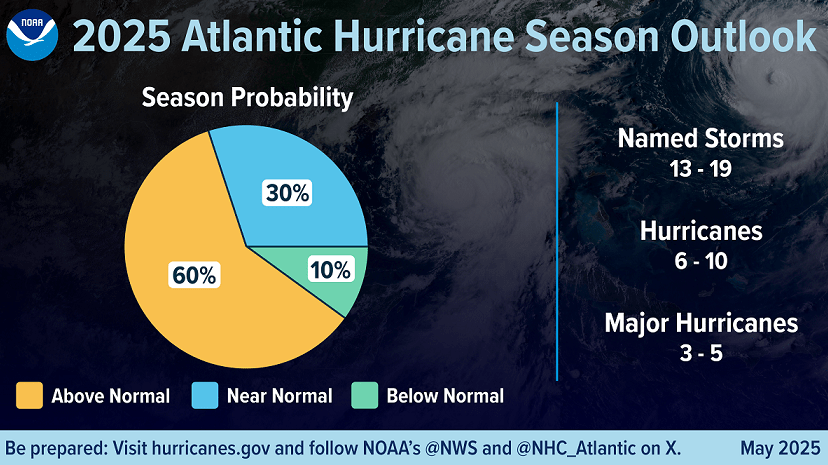
The National Oceanic and Atmospheric Administration is predicting above-normal hurricane activity for the upcoming hurricane season. NOAA’s 2025 Atlantic Hurricane Season Outlook predicts a 30% chance of a near-normal season, a 60% chance of an above-normal season, and a 10% chance of a below-normal season. The Atlantic hurricane season runs from June 1 to November 30.

NOAA is forecasting (with 70 percent confidence):

  • 13-19 total named storms (winds of 39 mph or higher)
  • 6-10 hurricanes (winds of 74 mph or higher)
  • 3-5 major hurricanes (winds of 111 mph or higher)


According to NOAA, the above-normal forecast is due to a confluence of factors, including ENSO-neutral conditions (neither El Niño nor La Niña). In addition to potentially higher activity from the West African Monsoon, which is a primary starting point for Atlantic hurricanes, NOAA notes that high-heat content in the ocean and reduced trade winds tend to favor tropical storm formation. The higher-heat content provides more energy to fuel storm development, while weaker winds allow the storms to develop without disruption.

Forecasters at Colorado State University’s Tropical Meteorology Project are similarly predicting an above-average 2025 Atlantic hurricane season. Their initial forecast is for 17 named storms, including nine hurricanes and four major hurricanes. The probability of a major hurricane (Category 3-4-5) making landfall somewhere along the east coast of the United States (including Florida) is 26 percent. The probability of a Gulf Coast landfall (from the Florida Panhandle to Brownsville, Texas) is 33 percent.

NOAA reminds us that the impacts of hurricanes can reach far beyond coastal communities, so preparations should not be limited to those living on or near the coast. As such, NOAA’s National Weather Service Director urges everyone to “be prepared. Take proactive steps now to make a plan and gather supplies to ensure you’re ready before a storm threatens.”

Remember, it only takes one storm to make it an active hurricane season for you. Please contact us to discuss affordable insurance options to protect your personal and business property during the 2025 hurricane season.

Florida Governor signs comprehensive condominium bill into law

By Anita Byer

On June 14, 2024, Florida Governor Ron DeSantis signed a comprehensive condominium bill into law. House Bill 1021 (Community Associations) includes numerous statutory amendments that relate to condominium governance and association management, most of which become effective July 1, 2024. That means board members do not have much time to determine if and how these amendments, including those set forth below, may affect their condominium association or its operations.

Milestone Inspections. Currently, single-family, two-family, and three-family dwellings are exempt from the milestone inspection requirements. On July 1, 2024, four-family dwellings with three or fewer habitable stories above ground will also be exempt from Florida’s milestone inspection requirements.

Official Records. Regarding an association’s official records, House Bill 1021:

  • provides that associations have a good faith obligation to obtain and recover lost or destroyed records;
  • makes e-mail addresses and facsimile numbers accessible to unit owners if consent to receive electronic notice has been provided (but prohibits selling or sharing such information to 3rd parties);
  • effective January 1, 2026, decreases from 150 units to 25 units the threshold requirement for an association to make specified records available on its website or on a mobile device; and
  • requires associations to maintain additional financial records (invoices and other documentation that substantiates receipts and expenditures).


Budgets, Financial Reporting, and Reserves. House Bill 1021:

  • prohibits associations from reducing the required type of financial statement (compiled, reviewed, or audited) for consecutive years; and
  • requires associations to provide unit owners with a notice that the structural integrity reserve study is available for inspection and copying within 45 days of completion, which may be provided electronically.


Meetings of Condominium Associations. The bill requires:

  • associations of 10 or more units to meet at least once each quarter, and at least four times each year, the meeting agenda must allow members an opportunity to ask questions of the board; and
  • notices for assessment meetings to include the cost and purpose of the assessments and a copy of any proposed contract.


Voting. Regarding voting in condominium associations, the bill:

  • requires associations to notify unit owners at least 90 days before an election that their voting rights may be suspended due to nonpayment of a fee or other monetary obligation; and
  • allows owners to electronically consent to electronic voting in elections.


Hurricane Protections. House Bill 1021 revises the requirements for the installation of hurricane protection, including:


Director Education. HB 1021 revises the education requirements for condominium officers and directors by requiring:

  • new directors to submit both the written certification that they have read the association’s governing documents, will work to uphold the documents to the best of their ability and faithfully discharge their duties, and submit a certificate of completion of an approved condominium education course;
  • four hours of training, including instruction on milestone inspections, reserve studies, elections, recordkeeping, finances, fines, and meetings;
  • directors to annually complete at least one hour of continuing education about recent changes to the condominium laws and rules during the past year; and
  • association directors to certify, on a form provided by the division, that all directors have completed the required written certification and educational certificate requirements.


Division of Condominium, Timeshares, and Mobile Homes. The bill expands the division’s post-turnover jurisdiction to include:

  • procedures and records related to various financial issues;
  • the election, removal and recall of board members;
  • maintenance of and access to association records;
  • meeting procedures (quorums, voting requirements, proxies, budget meetings, etc.);
  • conflicts of interest;
  • structural integrity reserve studies; and
  • written inquiries by unit owners to the association.


Pre-Sale Disclosures and Requirements. House Bill 1021 revises the form in which the prospective purchaser acknowledges receipt of specified documents, including a copy of the association’s most recent annual financial statement and annual budget.

Board members should be reviewing all new condominium-specific legislation, as well as any other applicable statutory amendments, to ensure compliance. A copy of House Bill 1021 is available here. Consultation with the association’s attorney may be necessary. Setnor Byer Insurance & Risk can help associations and board members identify, manage and insure their unique risks. Please contact our team to discuss the various risk management services we provide our condominium association clients, including our Division-Approved New Board Member Education.

NOAA is forecasting more named storms and hurricanes in 2024 than ever before

By Anita Byer, Setnor Byer Insurance & Risk

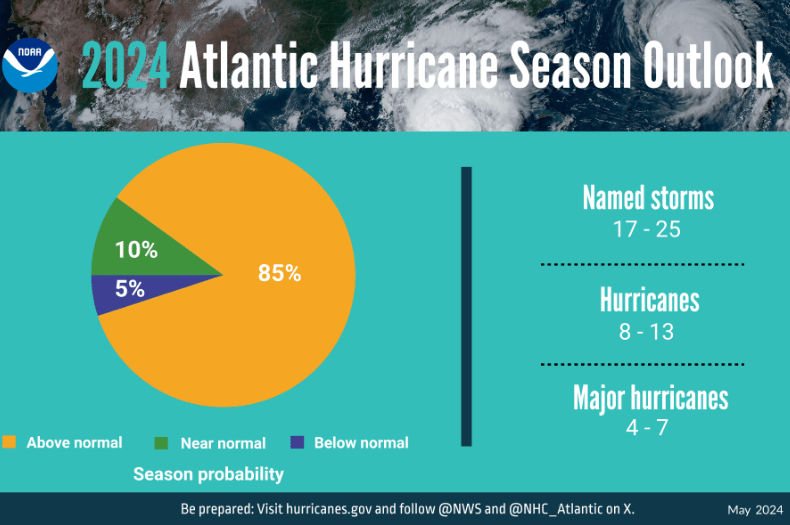
The National Oceanic and Atmospheric Administration is expecting above-normal hurricane activity during the 2024 Atlantic hurricane season. NOAA forecasters are predicting an 85 percent chance of an above-normal season, a 10 percent chance of a near-normal season and a 5 percent chance of a below-normal season. According to NOAA Administrator Dr. Rick Spinrad, “[t]his season is looking to be an extraordinary one in a number of ways…Of note, the forecast for named storms, hurricanes and major hurricanes is the highest NOAA has ever issued for the May outlook.” The Atlantic hurricane season runs from June 1 to November 30.

This year, NOAA is forecasting (with 70 percent confidence) a likely range of:

  • 17 – 25 Named Storms (winds of 39 mph or higher)
  • 8 – 13 Hurricanes (winds of 74 mph or higher)
  • 4 – 7 Major Hurricanes (winds of 111 mph or higher)

Like the forecast team at Colorado State University, NOAA identifies various factors in support of its above-normal forecast. According to NOAA, above-normal activity is expected due to a confluence of factors, including near-record warm ocean temperatures in the Atlantic Ocean, development of La Nina conditions in the Pacific, reduced Atlantic trade winds and less wind shear, all of which tend to favor tropical storm formation.

As one of the strongest El Ninos ever observed nears its end, NOAA scientists predict a quick transition to La Nina conditions, which lessen disruptive wind shear in the tropics. Abundant ocean heat also creates more energy to fuel storm development. An above-normal west African monsoon can produce African easterly waves that seed some of the strongest and longer-lived Atlantic storms. Finally, NOAA identifies light trade winds, which minimize ocean cooling and allow hurricanes to strengthen without the disruption of strong wind shear.

NOAA’s 2024 Atlantic Hurricane Season Outlook reminds us that individuals, businesses and communities must prepare now for the upcoming season. Remember, it only takes one storm to make it an active hurricane season for you. Please contact us to discuss affordable insurance options to protect your personal and business property during the 2024 hurricane season.

Broward County’s new flood zone maps will require thousands to purchase new flood insurance policies beginning July 31, 2024

By Anita Byer, Setnor Byer Insurance & Risk

The Federal Emergency Management Agency recently finalized Broward County’s new Flood Insurance Rate Maps (FIRMs). According to the City of Ft. Lauderdale’s Flood Plain Manager, Broward County’s new FIRM will expand the Special Flood Hazard Area by 15 percent. This is significant because home and business owners with mortgages from federally regulated or insured lenders are required to carry flood insurance if their property is located within a SFHA. Preliminary reports indicate that nearly one hundred thousand additional property owners will be required to carry flood insurance when Broward County’s new flood maps become effective July 31, 2024. Does that include you?

Flood zone maps are used to determine a property’s flood risk. Any place with a one percent (or higher) chance of experiencing a flood each year is considered to have a high risk and is placed in a Special Flood Hazard Area. While a one percent chance may not seem concerning, these areas have at least a one-in-four chance of flooding during a 30-year mortgage. FEMA’s high-risk flood zones include the following designations.

  • Zone AO indicates areas with a one percent chance of shallow flooding (1 to 3 feet) each year, usually in the form of sheet flow. Mandatory flood insurance purchase requirements apply.​​
  • Zone AH indicates areas with a one percent chance of flooding (1 to 3 feet) each year. Mandatory flood insurance purchase requirements apply.​​
  • Zone AE, which is typically found in areas that are close to oceans, rivers and lakes, indicates areas that have a one percent chance of flooding each year. Mandatory flood insurance requirements apply.
  • Zone VE indicates coastal areas that have additional hazards associated with storm waves. Mandatory flood insurance requirements apply.
  • Zone X (shaded) indicates areas with moderate flood risks (i.e., fewer floods or shallow floods). Flood insurance is not mandatory.
  • Zone X (unshaded) indicates areas determined to have a minimal risk of flooding. Flood insurance is not mandatory.

It is important to note that neighborhoods across Broward County may be affected differently by these new maps. Some properties will have the same flood risk as before, while others may be mapped into a higher-risk area. Those holding a mortgage with a federally-regulated lender may need to purchase flood insurance from the National Flood Insurance Program. Some private mortgage companies may also require flood insurance for structure that are mapped into a high-risk area.

Before the new flood maps become effective, those owning personal or business properties in Broward County need to find out whether their flood zone designations have changed and whether they will be required to purchase flood insurance. The new flood maps can be found here. Those that are not required to carry flood insurance under the updated flood maps are nevertheless encouraged to do so because “No-Risk-of-Flood” zones simply do not exist. Floods can happen wherever it rains.

The new flood maps take effect July 31, 2024, so Broward residents do not have much time to find out whether their flood zone designations have changed. Please contact us to find out whether you will need to purchase flood insurance because of Broward County’s new flood zone maps.

DOL issues final rule raising minimum salary threshold for FLSA’s “white collar” exemptions

By Anita Byer, Setnor Byer Insurance & Risk

The Department of Labor issued a final rule that will make it more expensive for employers to keep overtime-exempt employees on the payroll. On April 26, 2024, the DOL published a final rule that increases the minimum salary that executive, administrative and professional employees must be paid to be exempt from the Fair Labor Standards Act’s overtime pay requirements. The final rule also increases the total annual compensation threshold for the FLSA’s highly compensated employee (HCE) exemption. According to the DOL, in the first year after implementation of the final rule, approximately 4 million workers will either become eligible for overtime pay or have their salary increased.

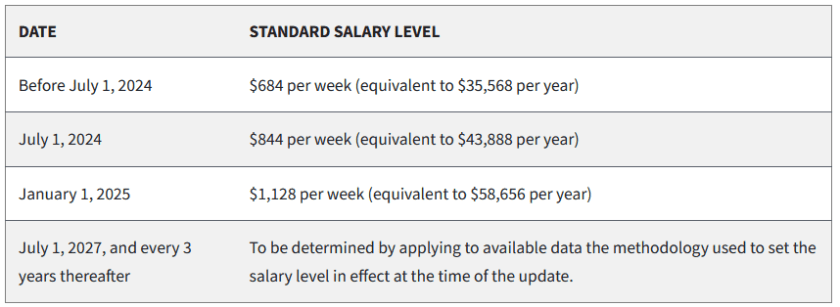
The current standard salary level for the FLSA’s white collar exemptions is $684 per week ($35,568 per year). Under the final rule, on July 1, 2024, the standard salary level will increase to $844 per week ($43,888 per year). On January 1, 2025, it will increase again to $1,128 per week ($58,656 per year). On July 1, 2027, and every three years thereafter, the standard salary level will be updated by applying current earnings data to the final rule’s salary methodology. (The DOL will publish a notice announcing the updated salary level amount at least 150 days before the update takes effect.)

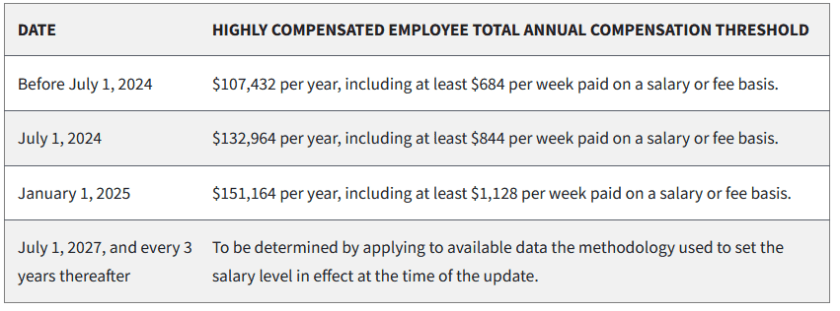
The final rule also increased the salary threshold used to determine whether a worker qualifies for the FLSA’s HCE exemption. On July 1, 2024, the annual compensation level needed to be an exempt HCE will increase from $107,432 to $132,964. On January 1, 2025, the annual compensation level will increase to $151,164. On July 1, 2027, and every three years thereafter, the HCE total annual compensation threshold will be updated by applying current earnings data to the final rule’s salary methodology. (The DOL will publish a notice announcing the updated salary level amount at least 150 days before the update takes effect.)

According to the DOL, in addition to expanding overtime protections to lower-paid salaried workers, the final rule ensures predictability. Regularly updating salary threshold to reflect changes in earnings protects against the future erosion of overtime protections. It is worth noting that the final rule, or parts of it, are likely to face legal challenges from those opposing its implementation. As a result, the final rule’s effective date may be extended, perhaps indefinitely.

Click here to read the published final rule. Click here for additional information from the Department of Labor. Since change often creates uncertainty, employers should carry Employment Practices Liability Insurance that includes limited wage & hour coverage. Please contact us if you would like to learn more about employment practices liability insurance.