Federal court blocks rule that raised minimum salary threshold for FLSA’s overtime exemptions

On November 15, 2024, a federal judge from the Eastern District of Texas vacated the latest overtime rule issued by the Department of Labor that would have made millions of previously exempt employees eligible for overtime compensation under the Fair Labor Standards Act. According to the DOL, in the first year after implementation of the new overtime rule, approximately 4 million workers would either become eligible for overtime pay or have their salary increased. This is no longer the case now that the final rule has been blocked by a federal court.

The DOL’s final rule significantly increased the minimum salary that executive, administrative and professional (“white-collar”) employees must be paid to be exempt from the FLSA’s overtime pay requirements. The federal court, however, found that the DOL exceeded its statutory authority by implementing these salary increases. According to the court, the DOL’s final rule is impermissible because it effectively eliminates consideration of whether an employee performs “bona fide executive, administrative, or professional capacity” duties in favor of what amounts to a salary-only test. “Congress elected to exempt employees based on the capacity in which they are employed. It’s their duties and not their dollars that really matter.”

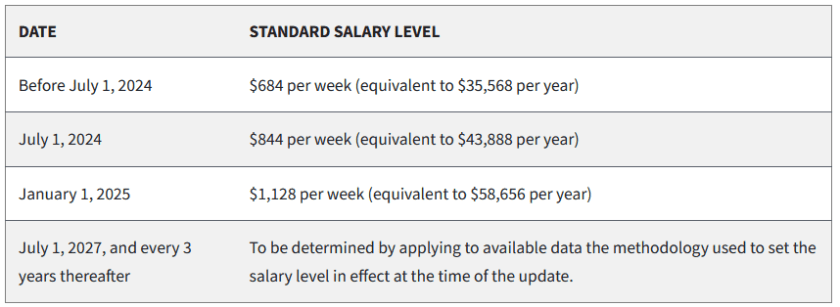
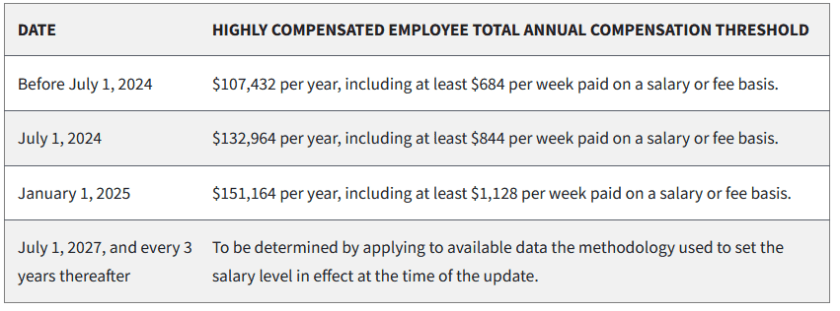
As a result of the court’s ruling, the standard salary level for the FLSA’s white collar exemptions will return to the pre-rule amount of $684 per week ($35,568 per year). The court also vacated the rule’s increased salary threshold for the FLSA’s highly compensated employee exemption, which will now remain at $107,432.

Since change often creates uncertainty, employers should carry Employment Practices Liability Insurance that includes limited wage & hour coverage. Please contact us if you would like to learn more about employment practices liability insurance.

DOL issues final rule raising minimum salary threshold for FLSA’s “white collar” exemptions

By Anita Byer, Setnor Byer Insurance & Risk

The Department of Labor issued a final rule that will make it more expensive for employers to keep overtime-exempt employees on the payroll. On April 26, 2024, the DOL published a final rule that increases the minimum salary that executive, administrative and professional employees must be paid to be exempt from the Fair Labor Standards Act’s overtime pay requirements. The final rule also increases the total annual compensation threshold for the FLSA’s highly compensated employee (HCE) exemption. According to the DOL, in the first year after implementation of the final rule, approximately 4 million workers will either become eligible for overtime pay or have their salary increased.

The current standard salary level for the FLSA’s white collar exemptions is $684 per week ($35,568 per year). Under the final rule, on July 1, 2024, the standard salary level will increase to $844 per week ($43,888 per year). On January 1, 2025, it will increase again to $1,128 per week ($58,656 per year). On July 1, 2027, and every three years thereafter, the standard salary level will be updated by applying current earnings data to the final rule’s salary methodology. (The DOL will publish a notice announcing the updated salary level amount at least 150 days before the update takes effect.)

The final rule also increased the salary threshold used to determine whether a worker qualifies for the FLSA’s HCE exemption. On July 1, 2024, the annual compensation level needed to be an exempt HCE will increase from $107,432 to $132,964. On January 1, 2025, the annual compensation level will increase to $151,164. On July 1, 2027, and every three years thereafter, the HCE total annual compensation threshold will be updated by applying current earnings data to the final rule’s salary methodology. (The DOL will publish a notice announcing the updated salary level amount at least 150 days before the update takes effect.)

According to the DOL, in addition to expanding overtime protections to lower-paid salaried workers, the final rule ensures predictability. Regularly updating salary threshold to reflect changes in earnings protects against the future erosion of overtime protections. It is worth noting that the final rule, or parts of it, are likely to face legal challenges from those opposing its implementation. As a result, the final rule’s effective date may be extended, perhaps indefinitely.

Click here to read the published final rule. Click here for additional information from the Department of Labor. Since change often creates uncertainty, employers should carry Employment Practices Liability Insurance that includes limited wage & hour coverage. Please contact us if you would like to learn more about employment practices liability insurance.

EEOC publishes final rule on Pregnant Workers Fairness Act

By Anita Byer, Setnor Byer Insurance & Risk

The Equal Employment Opportunity Commission recently issued a final rule to implement the Pregnant Workers Fairness Act (PWFA). The PWFA generally requires covered employers to reasonably accommodate a qualified employee’s or applicant’s known limitations related to, affected by, or arising out of pregnancy, childbirth, or related medical conditions, unless doing so will cause the employer an undue hardship. The PWFA, which went into effect June 27, 2023, generally applies to private employers and public sector employers that have 15 or more employees.

According to the EEOC, the final rule and interpretive guidance provide clarity to employers and employees (including applicants) about their respective rights and responsibilities under the PWFA. This is accomplished, in part, with detailed definitions and examples. Below are some key requirements and provisions of the PWFA and the final rule that employers must know to avoid violations.

Under the PWFA, a covered employer may not:

  • Fail to make a reasonable accommodation for the known limitations of a qualified employee, unless the accommodation would cause an undue hardship.
  • Require a qualified employee to accept an accommodation other than a reasonable accommodation arrived at through the interactive process.
  • Deny a job or other employment opportunities to a qualified employee or applicant based on the person’s need for a reasonable accommodation.
  • Require a qualified employee to take leave if another reasonable accommodation can be provided that would let the employee keep working.
  • Punish or retaliate against an employee or applicant for requesting a reasonable accommodation, opposing unlawful discrimination or participating in a PWFA proceeding.
  • Coerce individuals who are exercising their rights or helping others exercise their rights under the PWFA.


It is important to note that the PWFA applies only to accommodations. Claims of discrimination based on pregnancy, childbirth, or related medical conditions must be pursued under other laws prohibiting pregnancy-related discrimination, such as Title VII or the Americans with Disabilities Act. A reasonable accommodation is a change in the work environment or the way things are usually done at work. The final rule provides various examples, such as frequent breaks, telework, light duty, permitting employees to sit or stand, temporarily suspending one or more essential functions, and adjusting or modifying policies.

Significantly, the final rule identifies four simple modifications that will almost always be considered reasonable accommodations that do not impose an undue hardship when requested by a pregnant employee. These “predictable assessments” essentially require employers to allow pregnant employees to do the following, as needed:

  • carry or keep water nearby to drink;
  • take additional restroom breaks;
  • sit or stand during work; and
  • take breaks to eat and drink.


An employee or applicant who can perform the essential functions of the job with or without a reasonable accommodation is considered qualified under the PWFA. An employee can also be considered qualified if their inability to perform the essential job functions is temporary, the employee could perform the functions in the near future, and the inability to perform the essential functions can be reasonably accommodated. This, according to the EEOC, means that an employee who is temporarily unable to perform essential job functions may require light duty or a change in work assignments as a reasonable accommodation under PWFA.

Under the final rule, an employee requesting a reasonable accommodation must identify the limitation (the physical or mental condition related to, affected by, or arising out of pregnancy, childbirth, or related medical conditions) and that the employee needs an adjustment or change at work due to the limitation. Once the employer knows, it should engage in the interactive process with the employee or applicant to discuss the known limitation and the adjustment or change needed at work.

When considering reasonable accommodations under PWFA, the EEOC urges employers to keep the following tips in mind.

  • Train supervisors about the PWFA as they are particularly likely to receive accommodation requests.
  • Workers do not need to use specific words to request an accommodation. Once an employee requests an accommodation, employers must use the interactive process.
  • Limitations may be minor and may be associated with an uncomplicated pregnancy and may require accommodations that are easy to make.
  • A worker may need different accommodations as the pregnancy progresses, they recover from childbirth, or the related medical condition improves or gets worse.


Additional information about pregnancy-related discrimination is available from the EEOC.

Employers should carry Employment Practices Liability Insurance to protect against mistakes that are more likely to result from the confusion that always seems to accompany regulatory rule changes. Please contact us to learn more about EPLI coverage.


EEOC’s latest performance report highlights risk of employment-related lawsuits

By Anita Byer, Setnor Byer Insurance & Risk

The Equal Employment Opportunity Commission recently released its performance report for fiscal year 2023, which ended September 30, 2023. The EEOC is responsible for enforcing various federal equal employment opportunity laws. According to the EEOC, “the agency’s performance during FY 2023 reflects both an increased demand for its services and significant remedies for workers who suffered discrimination.” The data contained in its annual performance report can be used to better understand various employment-related liability exposures that continue to pose a significant risk to most employers.

In 2023, the EEOC experienced an increased demand for services from the public. It received 81,055 new discrimination charges, which is a 10% increase compared to fiscal year 2022. The EEOC also handled more than 522,132 calls and 86,008 emails from the public, representing respective increases of 10% and 25%. Yet, despite the increased workload, the EEOC managed to secure more than $665 million for victims of discrimination, including approximately:

  • $440 million for 15,143 victims of employment discrimination through mediation, conciliation, and settlements;
  • $22 million for 968 individuals in litigation;
  • $202 million for 5,943 federal employees and applicants.


The EEOC also filed 143 merits lawsuits in fiscal year 2023, the most since 2019. Merits lawsuits are direct suits or interventions alleging violations of the substantive provisions of the statutes enforced by the EEOC and suits to enforce administrative settlements. It is worth noting that the EEOC also strengthened its enforcement capabilities by filling nearly 500 new positions during fiscal year 2023, most of which are front-line staff, including investigators, mediators, and attorneys.

The lawsuits filed by the EEOC in fiscal year 2023 include 86 suits seeking relief for individuals, 32 non-systemic suits with multiple victims, and 25 systemic suits. These lawsuits alleged violations covering multiple bases, including retaliation (56), sex (50), disability (43), race (24), age (12), religion (10), and national origin (8). The issues raised most frequently in these suits were discharge (65), reasonable accommodation (43), hiring (including referral, recall, assignment, and job classification) (36), constructive discharge (34), and harassment (34).

In addition to its enforcement operations, the EEOC also made significant efforts to prevent employment discrimination and advance equal employment opportunities through education and outreach, including:

  • Conducting 3,318 in-person and virtual no cost outreach and fee-based training events for 314,199 individuals nationwide.
  • Increasing outreach to vulnerable workers and developing and enhancing partnerships with organizations that work with vulnerable workers.
  • Launching social media campaigns to provide members of the public greater access to information about their rights and responsibilities.
  • Increasing digital media products to enhance the public’s understanding of their rights and responsibilities under federal equal employment opportunity laws. As a result, the EEOC’s website had more than 12 million users (11% increase) and over 31.7 million page views (9.3% increase) in fiscal year 2023.


Employers can use the EEOC’s latest performance report to protect against employment-related liabilities. After all, it is much easier to avoid costly violations when you know where the EEOC is directing its attention and how it is allocating resources. However, given today’s rapidly changing environment, employers also need employment practices liability insurance (EPLI) because it is impossible to know what tomorrow may bring.

Please contact us to learn more about protecting your business with Employment Practices Liability Insurance.

When do employers need a Summary Plan Description?

By Anita Byer, Setnor Byer Insurance & Risk

If you are an employer sponsoring an employee group health plan, you must have an ERISA-compliant Summary Plan Description. The federal Employee Retirement Income Security Act (ERISA) is designed to protect plan participants by setting minimum disclosure standards for covered plans. An ERISA-covered group health plan is an employment-based plan that provides medical care coverage, including hospitalization, sickness, prescription drugs, vision or dental. Administrators of these plans, which often includes the employer/plan sponsor, are required to provide important plan information in writing in the form of a Summary Plan Description (SPD).

The Summary Plan Description is used to disclose and communicate important information about an employer’s employee benefit plan. It provides information about the plan, what benefits are available under the plan, the rights of participants and beneficiaries under the plan, and how the plan works. SPDs must be furnished to employees without charge within 90 days after the employee becomes a participant or within 120 days of the plan’s adoption date. SPDs must also be provided within 30 days of being requested.

Pursuant to ERISA regulations, the SPD must:

  • identify the plan name, plan number and employer identification number;
  • describe the type of plan (i.e., employee welfare benefit plan, employee benefit plan);
  • describe the type of plan administration;
  • provide contact information for the plan administrator and service of process;
  • describe the plan’s eligibility requirements;
  • describe circumstances which may result in disqualification, ineligibility, denial, loss, forfeiture, suspension or reduction of benefits;
  • state the date of the plan’s fiscal year;
  • describe the procedures governing claims for benefits, applicable time limits and remedies if claims are denied;
  • describe provisions governing termination of the plan; and
  • include a statement of rights available to plan participants under ERISA.

The SPD must also explain various aspects of the benefits being provided, such as the plan’s:

  • cost-sharing provisions, including costs of premiums, deductibles, coinsurance and co-payment requirements;
  • annual or lifetime caps or limits on benefits;
  • coverage for preventive services;
  • coverage for drugs, medical tests, devices and procedures;
  • the use of network providers, the composition of provider networks and whether, and under what circumstances, coverage is provided for out-of-network services;
  • conditions or limits on the selection of primary care providers or providers of specialty medical care; and
  • conditions or limits applicable to obtaining emergency medical care.

Since comprehension is the key, SPDs must follow strict style and formatting requirements. For example, SPDs must:

  • be written in a manner calculated to be understood by the average plan participant;
  • be sufficiently comprehensive to apprise participants of their rights and obligations under the plan;
  • not be formatted in a way that misleads or misinforms plan participants;
  • present the plan’s advantages and disadvantages without exaggerating the benefits or minimizing the limitations; and
  • ensure that the plan’s exceptions, limitations, reductions or restrictions are not minimized, rendered obscure or otherwise made to appear unimportant (style, caption, printing type and prominence must be the same as that used to describe plan benefits).

Plan administrators must consider the level of comprehension and education of typical plan participants and the complexity of the terms of the plan. In most cases, this requires limiting or eliminating technical jargon and long, complex sentences. It may also require the use of clarifying examples, illustrations, clear cross references and a table of contents.

Unlike these general descriptions, ERISA’s SPD requirements are highly technical and very specific. Employers must ensure strict compliance with all applicable rules. Given ERISA’s relative complexity, employers may need to consult licensed professionals to avoid the potentially severe consequences that can result from violations. In addition to having an ERISA fidelity bond to protect against losses due to fraud or dishonesty by persons handling funds, employers should also carry employment practices liability insurance.

Please contact us about affordable group health plan options and ways to limit the accompanying liabilities.

FTC proposes ban on non-compete clauses for employees

By Anita Byer, Setnor Byer Insurance & Risk

The Federal Trade Commission recently proposed a new rule that would ban the use of non-compete clauses in employment agreements. The FTC believes that the widespread use of non-compete clauses suppresses wages, hampers innovation and stifles entrepreneurship. According to FTC estimates, the proposed rule could increase wages by nearly $300 billion per year and expand career opportunities for millions of Americans. It could also cause inconvenience, disruption and even financial harm to countless individuals and businesses nationwide. A watershed moment indeed, but for better or worse?

Under the proposed rule, the use of non-compete clauses would be considered an unfair method of competition. As such, it would be unlawful for an employer to:

  • enter into or attempt to enter into a non-compete clause with a worker;
  • maintain a non-compete clause with a worker; or
  • represent to a worker, under certain circumstances, that the worker is subject to a non-compete clause.

The notable breadth of the proposed rule comes from its definitions. “Worker” is defined broadly to mean any natural person who works for an employer, whether paid or unpaid, including employees, independent contractors, interns and volunteers. A “non-compete clause” is any contractual term between an employer and a worker that prevents the worker from seeking or accepting employment, or operating a business, after the conclusion of the worker’s employment with the employer. This already broad definition is made even broader by including de facto non-compete clauses.

A de facto non-compete clause is any contractual term that has the effect of prohibiting a worker from seeking or accepting employment or operating a business after the conclusion of the worker’s employment with the employer. A non-disclosure agreement, for example, could be considered a de facto non-compete clauses if it is written so broadly that it effectively precludes the worker from working elsewhere in the same field. If the proposed rule is adopted, this functional test to determine whether a contractual term should be interpreted as a prohibited non-compete clause seems to be fertile ground for litigation.

So, what happens to existing non-compete clauses under the proposed rule? If adopted as is, the rule would require employers to rescind existing non-compete clauses with workers and actively inform their employees that the contracts are no longer in effect. The rule, however, does have a limited sale-of-business exception that allows a person who owns at least 25 percent of a business entity to execute a non-compete clause as part of a sales transaction.

It’s important to note that this is not a final rule. If and when the FTC publishes a final rule, it may be substantially different than the proposed rule. However, since any such rule could have potentially significant implications, employers should be paying attention to the FTC and its desire to essentially prohibit the use of non-compete clauses. Those not comfortable taking the wait-and-see approach are free to participate in the rule-making process. The FTC is accepting public comments on the proposed rule through March 10, 2023. So, what do you think? Should non-compete clauses be banned?

If adopted, the proposed rule would supersede any inconsistent state statute, regulation, order or interpretation, altering the nature employer / employee relationships nationwide. Please contact us to discuss the value of having Employment Practices Liability insurance coverage in this rapidly changing regulatory environment.

Florida minimum wage increasing by $1 on September 30th

By Anita Byer, Setnor Byer Insurance & Risk

In case you forgot, Florida’s minimum wage is increasing by $1 at the end of the month. On September 30, 2022, Florida’s minimum wage will increase to $11 per hour. The minimum wage for tipped employees, which must be paid in addition to tips, will increase to $7.98 per hour. This increase is required by the $15 Minimum Wage Ballot Initiative (Amendment 2) approved by Florida voters in November 2020.

Amendment 2 increases Florida’s minimum wage incrementally over a period of years until it reaches $15 per hour in 2026. The first (and largest) minimum wage increase happened last year. Future increases are set to occur annually on September 30th per the following schedule.

2022                $11.00

2023                $12.00

2024                $13.00

2025                $14.00

2026                $15.00

Annual adjustments for inflation, which have taken place since 2005, are scheduled to resume September 2027. Florida’s Minimum Wage Act is interpreted and applied much like the federal Fair Labor Standards Act. Employers must pay no less than the federal minimum wage or their state’s minimum wage, whichever is higher. Florida’s 2022-2023 minimum hourly wage remains higher than the current federal minimum hourly wage of $7.25.

Florida’s constitutional minimum wage requirements remain otherwise unchanged by Amendment 2. Employers, for example, are still prohibited from discriminating or retaliating against employees for exercising their constitutional minimum wage rights. Employers can still be sued by employees and Florida’s Attorney General for violating these rights. These lawsuits are still expensive.

Covered employers are also still required to post the required minimum wage notice in the workplace. Per Florida law:

  • the notice must be posted prominently in a conspicuous and accessible place in each establishment where minimum wage employees are employed;
  • the poster must be at least 8.5 inches by 11 inches and in a format easily seen by employees;
  • the text in the poster must be of a conspicuous size;
  • the text in the first line must be larger than the text of any other line; and
  • the text of the first sentence must be in bold type and larger than the text in the remaining lines.

To reduce the likelihood of costly mistakes, employers should provide wage and hour training to managers and supervisors. Employers should also carry Employment Practices Liability Insurance with limited coverage for wage and hour claims. Contact us to learn more about protecting your business with Employment Practices Liability Insurance.

New EEOC guidance limits employers’ ability to test employees for COVID-19

By Anita Byer, Setnor Byer Insurance & Risk

New guidance from the Equal Employment Opportunity Commission may limit an employer’s ability to test employees for COVID-19 going forward. This is a particularly significant development as COVID-19 transmission rates surge nationwide. On July 12, 2022, the EEOC updated a number of its Technical Assistance Questions and Answers, including those addressing reasonable accommodation, personal protective equipment and vaccinations. But what seems to be getting special attention is the EEOC’s new position regarding an employer’s ability to administer COVID-19 tests in the workplace under the Americans with Disabilities Act.

The EEOC addressed whether the ADA permits employers to administer a viral test (to detect the presence of COVID-19) when evaluating an employee’s presence in the workplace. Recall that the EEOC’s position at the outset of the pandemic was that the ADA standard for conducting medical examinations was always met for employers to conduct worksite COVID-19 viral testing. Today, the EEOC’s position is slightly different.

According to the EEOC, employers may still administer COVID-19 viral tests in the workplace, but only if the employer can show it is job-related and consistent with business necessity. Employers no longer have an absolute right to administer COVID-19 viral tests in the workplace. So, how does an employer establish business necessity?

Per the EEOC, employers use of viral testing will meet the business necessity standard when it is consistent with current guidance from the Centers for Disease Control and Prevention, the Food and Drug Administration or state/local public health authorities. According to the EEOC, possible considerations in making the business necessity assessment may include:

  • the level of community transmission,
  • the vaccination status of employees,
  • the accuracy and speed of processing for different types of COVID-19 viral tests,
  • the degree to which breakthrough infections are possible for employees who are “up to date” on vaccinations,
  • the ease of transmissibility of the current variant(s),
  • the possible severity of illness from the current variant,
  • what types of contacts employees may have with others in the workplace or elsewhere that they are required to work (e.g., working with medically vulnerable individuals), and
  • the potential impact on operations if an employee enters the workplace with COVID-19.

The EEOC also addressed antibody (serology) tests, which are used to determine prior infections. Unlike viral testing, the process for determining whether antibody testing is permissible in the workplace is much simpler. They aren’t.

According to the CDC, antibody testing may not show whether an employee has a current infection or has immunity from a prior infection or vaccination. Given these deficiencies, the EEOC has taken the position that antibody testing does not meet the ADA’s “business necessity” standard for medical examinations or inquiries. Therefore, requiring antibody testing before allowing employees to re-enter the workplace is not allowed under the ADA.

The EEOC’s updated business necessity assessment for viral testing introduces a new process for employers to follow. Those wanting to commence or continue viral testing of employees in the workplace should review their current policies and procedures to ensure compliance with the EEOC’s updated guidance. To reduce the likelihood of a testing-related ADA claim, employers should proceed cautiously and consult legal counsel if necessary. Employers should also carry Employment Practices Liability Insurance to cover the high cost of defending actual and alleged claims of unlawful conduct.

Please contact us for additional information about protecting your business against employment-related claims.

DHS proposes Form I-9 overhaul and extends pandemic-related compliance flexibilities

By Anita Byer, Setnor Byer Insurance & Risk

The Department of Homeland Security is proposing an overhaul of its Employment Eligibility Verification form a/k/a Form I-9. This form is used by employers to verify the identity and employment authorization of every employee hired in the United States, regardless of citizenship. According to the Bureau of Labor Statistics, 78 million people were hired over the past twelve months, so any changes to Form I-9 will affect millions of employers and employees alike.

DHS is proposing the following changes to Form I-9 before the current version expires October 31, 2022. The public is invited to submit comments about the proposed revisions until May 31, 2022.

  • Compress Sections 1 and 2 from two pages to one page to reduce paper use and storage burden on employers. Section 1 (Information and Attestation) is completed by the employee. Section 2 (Review and Verification) is completed by the employer or its authorized representative.
  • Change Section 3 (Reverification and Rehires) to a supplement that provides three separate areas to enter reverifications and rehires within 3 years of the date of the initial execution of an employee’s Form I-9. Employers would only print and use the supplement as needed, further reducing paper use and storage burdens on employers.
  • Update the List of Acceptable Documents to include a link to List C documents issued by DHS and acceptable receipts that may be presented in lieu of a listed document for a temporary period.
  • Reduce and simplify the instructions from 15 pages to 7 pages, further reducing paper usage.
  • Remove electronic PDF enhancements to ensure that it can be completed on all electronic devices and is not software dependent.

DHS also extended the pandemic-related Form I-9 flexibilities until October 31, 2022. Per the initial flexibility announcement in March 2020, the requirement that employers inspect employees’ Form I-9 identity and employment eligibility documentation in-person applies only to those employees who physically report to work at a company location on any regular, consistent or predictable basis. An employee working exclusively in a remote setting due to COVID-19 are temporarily exempt from the physical inspection requirements until they undertake non-remote employment on a regular, consistent or predictable basis, or the extension of the flexibilities related to such requirements is terminated, whichever is earlier.

The broad use of Form I-9 means that any changes will affect all employers. Though transitioning to a new Form I-9 should not be too disruptive, employers need to recognize that confusion and error typically accompany change. Since the failure to ensure proper Form I-9 procedures may expose an employer to civil and possibly criminal penalties, steps must be taken to ensure a smooth and effective transition to the new Form I-9. Employers also need employment practices liability insurance (EPLI) to protect against the uncertainty that accompanies the enactment of any new law.

Please contact us to learn more about protecting your business with Employment Practices Liability Insurance.

New law ends forced arbitration of sexual harassment claims

By Anita Byer, Setnor Byer Insurance & Risk

A new federal law prohibits employers from forcing employees to arbitrate sexual harassment claims. The Ending Forced Arbitration of Sexual Assault and Sexual Harassment Act invalidates pre-dispute agreements that force employees to resolve claims of sexual harassment through arbitration instead of litigation. Approximately 60 million American workers are bound by forced arbitration clauses in their employment agreements. However, as of March 3, 2022, those with claims of sexual harassment can have their day in court.

The Act, which passed with broad bipartisan support, amends the Federal Arbitration Act to make pre-dispute arbitration agreements for sexual harassment disputes invalid and unenforceable. A pre-dispute arbitration agreement is any agreement to arbitrate a dispute that had not yet arisen at the time the agreement was made. This definition is broad enough to include most employment agreements that require arbitration. A sexual harassment dispute is a dispute relating to conduct that is alleged to constitute sexual harassment under applicable federal, tribal or state law.

The Act also invalidates pre-dispute joint-action waivers. These are agreements that prohibit one party (the employee) from participating in a joint, class or collective action involving a dispute that has not yet arisen at the time the agreement is made. Employees are no longer bound by these pre-dispute joint-action waivers, regardless of whether the waiver is part of the pre-dispute arbitration agreement.

Disagreements regarding the Act’s applicability to a specific claim are resolved by a court, not an arbitrator. As a result, many employers will ultimately end up where they least wanted to be. However, it’s important to note that the Act applies to pre-dispute arbitration agreements. It does not prohibit the parties from mutually agreeing to arbitration after a claim has arisen. The Act also applies at the election of the person making the claim, so employees are free to proceed pursuant to their employer’s pre-dispute arbitration agreement if they wish.

Employers must understand that the Act applies to disputes or claims that arise or accrue on or after March 3, 2022. It applies to all pre-dispute arbitration agreements, even those that predate the new law. Given the popularity of pre-dispute arbitration agreements, many employers will need to review their employment contracts and consult with counsel to determine how the new law will affect them going forward. Employers also need employment practices liability insurance (EPLI) to protect against the uncertainty that accompanies the enactment of any new law.

Please contact us to learn more about protecting your business with Employment Practices Liability Insurance.