Florida passes sweeping reforms to fix crumbling property insurance market

By Anita Byer, Setnor Byer Insurance & Risk

Florida lawmakers just passed sweeping property insurance reforms to repair the state’s crumbling property insurance market. The Florida Legislature convened a second special legislative session in mid-December to address the current property insurance crisis. While significant reforms were passed during the first special session, they aren’t nearly as bold or consequential as the reform bill passed during the second, which was promptly approved by Governor DeSantis.

The bill contains comprehensive reforms intended to ensure Floridians have access to quality, affordable private market property insurance. The reforms, like the problems that prompted them, are wide-ranging and far-reaching. Many are significant. Some are unprecedented. Let’s review some of the bill’s key provisions.

Claims filing deadline. The bill reduces the amount of time policyholders have to file or reopen a property insurance claim from two years to one year. The time to file a supplemental claim is reduced from three years to 18 months.

Prompt pay laws. The bill amends Florida’s prompt pay laws to encourage the prompt payment of claims by:

  • reducing the time for insurers to pay or deny a claim from 90 to 60 days;
  • reducing the time for insurers to review and acknowledge claim communications from 14 to 7 days;
  • reducing the time for insurers to begin an investigation from 14 to 7 days;
  • reducing the time to conduct physical inspections from 45 to 30 days;
  • permitting insurers to use electronic methods to investigate losses and communicate with policyholders; and
  • requiring insurers to send an adjuster’s loss estimate to policyholders within 7 days after it is created.

Awards of attorney fees in litigation involving property insurance policies. The bill seeks to reduce frivolous litigation arising from residential and commercial property insurance policies by:

  • eliminating various one-way attorney fee provisions throughout the insurance code for suits arising from property insurance policies;
  • making the civil offer of judgment statute applicable to suits arising from property insurance policies;
  • allowing joint offers of settlement that are contingent on acceptance of all joint offerees; and
  • removing provisions regarding attorney fees relative to the alternative procedure for resolution of disputed sinkhole insurance claims.

Assignments of benefits (AOBs). The bill prohibits any assignment of any post-loss insurance benefit under any residential or commercial property insurance policy issued on or after January 1, 2023.

Bad faith failure to settle actions against property insurers. The bill provides that bad faith litigation for failure to settle a property insurance claim may not be filed until after the insured has established through adverse adjudication by a court that the insurer breached the insurance contract and a final judgment or decree has been rendered against the insurer.

Flood insurance notice. The bill amends the mandatory flood insurance notice by requiring it to be part of the declarations page and makes revisions to the content of notice to encourage purchase of flood insurance.

Arbitration. The bill allows insurers to offer (but not require) policies that include a mandatory binding arbitration clause. Insurers must also provide an appropriate premium discount in exchange for the rights given up by the policyholder.

Citizens Property Insurance Corporation (Citizens). The bill:

  • Increases Citizens’ renewal eligibility threshold for personal lines policyholders to make them ineligible for renewal with Citizens upon receiving an offer of comparable coverage from an authorized insurer for a premium that is not more than 20 percent greater than Citizens’ renewal premium.
  • Increases Citizens’ eligibility threshold for new commercial residential policies from 15 to 20 percent.
  • Requires that rates charged by Citizens be actuarially sound and non-competitive with the approved rates charged in the admitted market.
  • Increases the potential rates charged for property that is not a primary residence.
  • Repeals language allowing policyholders to return to Citizens as a renewal if the take-out carrier increases their rates above the Citizens’ glidepath.
  • Requires personal lines residential policyholders to have qualifying flood insurance to be eligible for coverage.

These, and other provisions within the bill, can fairly be described as the most significant property insurance reforms in recent history, but their effectiveness remains to be seen. Will they strengthen Florida’s property insurance market? Will Floridians soon see more options and lower prices? We certainly hope so, but only time will tell. In the meantime, our team is available to discuss how these reforms may affect your personal and commercial property insurance coverages.


Florida approves 8.4% workers’ compensation rate reduction for 2023

By Anita Byer, Setnor Byer Insurance & Risk

Florida employers will be paying less for workers’ compensation insurance in 2023. The Florida Office of Insurance Regulation approved an overall average statewide decrease of 8.4 percent in workers’ compensation insurance premiums. The rate decrease will apply to new and renewal policies beginning January 1, 2023. This is the seventh consecutive year workers’ compensation rates have gone down in Florida.

The 8.4 percent rate reduction was initially proposed by the National Council on Compensation Insurance (NCCI), a rating organization authorized to make rate filings on behalf of workers’ compensation insurance companies in Florida. The reduction was based on NCCI’s analysis of claims experience data for the 2019 and 2020 policy years as of year-end 2021. According to NCCI:

  • favorable claims experience has been observed during these time periods;
  • Florida’s frequency of lost-time claims (injured employee receives wage replacement benefits) has generally declined over the most recent eight years; and
  • Florida’s average indemnity cost per case have been relatively consistent over time, while those for medical have been slightly more volatile from year-to-year.

NCCI notes that the rate reduction not influenced by the pandemic as its analysis did not include COVID-19 claims data. Nevertheless, NCCI’s assessment of possible pandemic-related impacts revealed that:

  • most COVID-19 claims are medical-only or indemnity-only and continue to be small (less than $1,500);
  • large claims (over $100,000) account for fewer than 2% of all COVID-19 claims, but more than 60% of total COVID-19 losses;
  • most claimants were employed in the healthcare industry;
  • the average age of workers with large claims is 55, which is 8-10 years older than that those with non-COVID claims; and
  • COVID-19 claims decreased significantly in 2021.

Although rates are going down next year, NCCI cautions that inflation has the potential to negatively influence the workers’ compensation system nationwide. Wage inflation is a concern as many workers, particularly those in leisure and hospitality, have seen significant pay increases recently. This directly impacts the cost of workers’ compensation insurance because payroll is used as the base to calculate premium. Rising medical claim costs (medical inflation) can also lead to higher premiums.

Contact us to learn more about the upcoming workers’ compensation rate reduction.

Florida’s Property Insurance Crisis: Facts Behind the Myths

By Anita Byer, Setnor Byer Insurance & Risk

Florida’s property insurance market is in the midst of a crisis. According to the Insurance Information Institute, Florida’s domestic property insurers had net underwriting losses of more than $1 billion in both 2020 and 2021. In 2022, an unprecedented six insurance companies were forced into liquidation due to insolvency. Add to this the fact that a number of Florida’s property insurers are steadily reducing their exposure by writing fewer and more restrictive property insurance policies. To make matters worse, insurers are currently inundated with claims caused by Hurricane Ian, which is expected to be the costliest natural disaster in Florida’s history at a price tag of $50 billion, according to Corelogic. So, what does the future hold for the millions of Floridians who need property insurance? Fewer choices and higher premiums. We cannot continue down this path. Florida’s property insurance market must be fixed to prevent this crisis from becoming a catastrophe.

While the news may seem grim, and the future of the Florida insurance marketplace in question, it is possible to return the property insurance marketplace to profitability, which will also allow insurers to reduce premiums to affordable levels despite the 1350 miles of coastline exposure to high winds and flooding. But the system is in dire need of change, and this change will require commitment and compromise from all stakeholders, including insurers, insureds, lawyers and lawmakers.

In December, we will all be witness to, yet, another attempt by the legislature to repair what many refer to, in part, as a man-made insurance crisis brought about by fraud, inflated claims, litigation abuse, misguided government policies and some insurer mismanagement on claims settlement matters. To this, we need to seriously consider the implications of a Hurricane Andrew type event making landfall on the southeast coast of Florida and the estimated $72 billion insured loss price tag that will come with such an event.

The insured loss numbers are staggering, so it is critical to address the waste within the system so that all possible dollars are deployed for recovery, efficiently and fairly, and domestic property insurers returned to profitability. And, whether one considers insurance companies friend or foe, 2022 claims litigation expenses are more than double that of 2016, with over $3 billion, annually, spent by insurers for defense costs and containment, as reported by the Office of Insurance Regulation (OIR).  More sobering news from the OIR details that while Florida accounts for approximately 7% of all homeowners’ claims filed in the country, these claims account for nearly 80% of all countrywide litigation. Along with this data, it should be noted that business organizations across the state report that a majority of the excess costs built into the system never find their way to the rightful beneficiary — the insured.

Another important element to consider when looking at the property insurance crisis, is the dominance of Citizens, which has grown to insure over 1 million policies, largely in the southeast. It is the position of the business-leaning legislators that a state subsidized entity should not compete with private enterprise, and that Citizens needs to return to its original mission of being an insurer of ‘last resort.’ Citizens, with its actuarially unsound (suppressed) pricing, will shortly become the insurer of choice for many residents unless pricing more closely resembles the private marketplace. And, while many insureds may find that Citizens offers pricing at more affordable levels than the private marketplace, and would be reluctant to support legislation that requires Citizens to charge ‘sound’ rates, it should be noted that any financial deficits of Citizens following a storm will cause unheard of additional costs to insureds through a required assessment of up to 75%.

While a handful of legislators and insiders are in general agreement on how to address the waste and inefficiencies in the system, and are prepared to move forward with draft legislation, experts will tell you that the ultimate fix needs to include: laws that are fair and balanced; a robust consumer protection element for unjust claims settlements; temporary financial support from the state IF insurers are unable to secure affordable reinsurance at primary levels in 2023; and a fix to Citizens’ underwriting and pricing structure, so that the private marketplace can thrive. Most importantly, Florida needs to make changes to claims settlement matters that disincentivize wasteful litigation brought by plaintiff attorneys and keeps insurers accountable.

Without the inflationary claims defense costs baked into the system and the full burden of primary reinsurance costs that are expected to increase significantly, insurers will have a fighting chance to survive and offer Floridians property insurance at lower costs and with more favorable policy terms and conditions, eventually and hopefully.

Risk of residential fire more than doubles on Thanksgiving

By Anita Byer, Setnor Byer Insurance & Risk

Did you know that the risk of a residential fire more than doubles on Thanksgiving Day? In fact, …

  • The average number of residential fires is 2.3 times higher on Thanksgiving than all other days of the year.
  • Cooking is the leading cause of all Thanksgiving fires (74 percent).
  • More than half of all Thanksgiving fires (54 percent) occurred from 10 a.m. to 5 p.m.
  • Most Thanksgiving fires (60 percent) happen in 1- and 2-family dwellings.

The good news is that it’s pretty easy to effectively reduce to risk of a Thanksgiving fire in your home. Here are ten tips from FEMA to help keep your family and friends safe this year.

  1. Stand by your pan. If you leave the kitchen, turn the burner off.
  2. Keep an eye on what you fry. Most cooking fires start when frying food.
  3. Roll up your sleeves. This reduces the chance that they’ll catch fire.
  4. Supervise children and pets. Make sure they stay away from the stove.
  5. Watch what you’re cooking. If you see smoke, or grease starts to boil, turn the burner off.
  6. If there’s an oven fire, keep the door closed. Turn off the oven and keep the door closed until it’s cool.
  7. Move things that can burn away from the stove. This includes dishtowels, bags, boxes, paper and curtains.
  8. Turn pot handles toward the back of the stove. This makes it harder to bump them or pull them over.
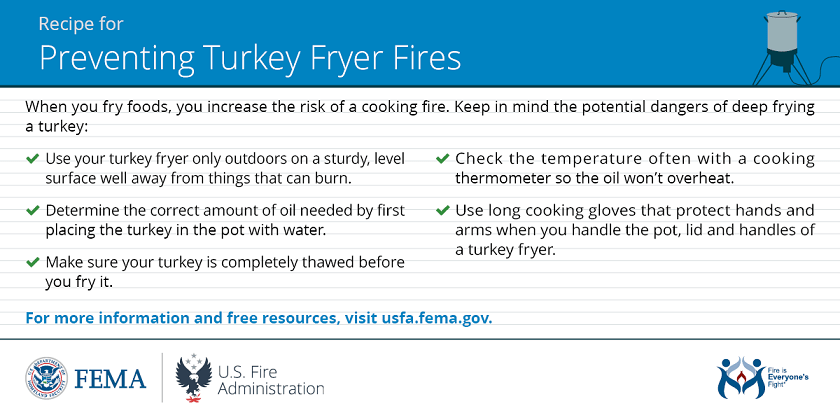
  9. Only use a turkey fryer outdoors. Place it on a sturdy surface, away from things that can burn.
  10. Check smoke alarms. Working smoke alarms should be close to where anyone may be sleeping.

FEMA also offers the following “recipe” for preventing turkey fryer fires.

Happy Thanksgiving!

EEOC releases new “Know Your Rights” poster; replaces “EEO is the Law” poster

By Anita Byer, Setnor Byer Insurance & Risk

At a glance…

  • The EEOC released a new mandatory workplace poster – Know Your Rights: Workplace Discrimination is Illegal – to replace the previous EEO is the Law poster.
  • The new poster includes various changes, including the addition of a QR code for fast digital access to the EEOC’s file a charge webpage.
  • Most private employers are required to post the new poster in a conspicuous place upon its premises where notices to employees and applicants are customarily maintained.
  • Download Know Your Rights: Workplace Discrimination is Illegal and post it now.

The Equal Employment Opportunity Commission released a new mandatory workplace poster entitled Know Your Rights: Workplace Discrimination is Illegal. This new poster was created to update and replace the ubiquitous EEO is the Law poster. Not familiar with this poster? Check the bulletin board in your employee break room and look behind the ancient flyers for garage sales and guitar lessons. Once you find it, take it down and replace it with the new poster. Because the Know Your Rights poster, like its predecessor, must be prominently displayed in most private workplaces.

Every covered employer is required to conspicuously post the new Know Your Rights poster upon its premises. This includes every employer covered by Title VII of the Civil Rights Act, the Americans with Disabilities Act or the Genetic Information Nondiscrimination Act. The poster summarizes various laws enforced by the EEOC and includes information about discrimination based on:

  • race, color, sex (including pregnancy and related conditions, sexual orientation, gender identity), national origin, religion;
  • age (40 and older);
  • equal pay;
  • disability and genetic information; and
  • retaliation.

The Know Your Rights poster includes a number of changes designed to make it easier for employers to understand their legal responsibilities and for workers to understand their legal rights and how to contact EEOC for assistance. The new poster:

  • uses straightforward language and formatting;
  • notes that harassment is a prohibited form of discrimination;
  • clarifies that sex discrimination includes discrimination based on pregnancy and related conditions, sexual orientation or gender identity;
  • adds a QR code for fast digital access to the how to file a charge webpage; and
  • provides information about equal pay discrimination for federal contractors.

The Know Your Rights poster must be posted in a conspicuous place where notices to applicants and employees are customarily posted. In addition to physically posting, the EEOC encourages covered employers to conspicuously post the notice digitally on their website. In most cases, electronic posting supplements the physical posting requirement. However, for employers without a physical location or employees working remotely, it may be the only posting.

Finally, be sure to use the correct version of the new poster, which you can download here. The following notice was posted on the EEOC’s website. “Employers, please note a new version of the “Know Your Rights: Workplace Discrimination is Illegal” poster has replaced and supersedes a version uploaded on 10/19. Please use the version marked “(Revised 10/20/2022)” going forward. We apologize for any inconvenience.”

Failing to post the Know Your Rights poster as required may result in a fine (adjusted for inflation) that is currently up to $612 per offense. To protect against costly employment-related claims, employers should have a policy prohibiting workplace discrimination and harassment. Managers and employees should be trained to prevent and avoid unlawful behavior. Employment Practices Liability Insurance is also needed to cover the high cost of defending actual and alleged claims of unlawful conduct.

Please contact us to learn more about EPLI coverage.

DOL proposes new rule for determining independent contractor status…again

By Anita Byer, Setnor Byer Insurance & Risk

At a glance…

  • The Department of Labor is proposing a new rule to determine whether a worker is an employee or an independent contractor under the Fair Labor Standards Act.
  • The proposed rule rescinds the 2021 Independent Contractor Rule and restores the multifactor, totality-of-the-circumstances analysis to determine independent contractor status under the FLSA.
  • According to the DOL, the proposed rule is more consistent with longstanding judicial precedent and will provide consistency for employers.
  • The proposed rule, if finalized, would likely increase the number of workers who would be considered employees under the FLSA.
  • The DOL extended the deadline to submit comments on the proposed rule to December 13, 2022. Substantial opposition to the proposed rule is expected.

The Department of Labor is proposing a new rule for determining independent contractor status under the Fair Labor Standards Act. This is significant because correctly classifying workers as employees or independent contractors is crucial for businesses. The correct classification isn’t always obvious and misclassifications can be costly. Unfortunately, the rules for determining independent contractor status lack uniformity and have recently become increasingly inconsistent and uncertain. Time will tell whether the new proposed rule will fix the problem, or just extend it.

According to the DOL, the proposed rule adopts a framework more consistent with longstanding judicial precedent under the FLSA. The DOL believes that the new rule preserves essential worker rights and provides consistency for employers and businesses. To that end, the proposed rule:

  • Aligns the DOL’s approach with courts’ FLSA interpretation and the economic reality test.
  • Restores the multifactor, totality-of-the-circumstances analysis to determine whether a worker is an employee or an independent contractor under the FLSA.
  • Ensures all factors are analyzed without assigning a predetermined weight to a particular factor or set of factors.
  • Reverts to the longstanding interpretation of the economic reality factors.
  • Rescinds the 2021 Independent Contractor Rule.

The proposed rule focuses on the economic realities of the worker’s relationship with the employer. A worker is an independent contractor if the worker is, as a matter of economic reality, in business for themself. Six factors must be considered to determine the economic realities of the working relationship and the question of economic dependence.

  1. Opportunity for profit or loss depending on managerial skill.
  2. Investments by the worker and the employer.
  3. Degree of permanence of the work relationship.
  4. Nature and degree of control.
  5. Extent to which the work performed is an integral part of the employer’s business.
  6. Skill and initiative.

No one factor or subset of factors is necessarily dispositive, and the weight given each factor may depend on specific facts and circumstances. Moreover, these six factors are not exhaustive. Additional factors may be considered relevant under some circumstances. Unfortunately, different circumstances can affect the relevancy of any specific factor, so it’s nearly impossible to adopt a one-size-fits-all approach to making this determination.

Despite (or because of) the DOL’s new proposed rule, the difficulty and uncertainty surrounding independent contractor classifications is likely to continue. Employers should carry Employment Practices Liability Insurance to protect against mistakes that are more likely to result from the confusion that always seems to accompany proposed regulatory changes. Please contact us to learn more about EPLI coverage.

Are you taking advantage of Cybersecurity Awareness Month?

By Anita Byer, Setnor Byer Insurance & Risk

October is Cybersecurity Awareness Month. This year’s theme, See Yourself in Cyber, is meant to communicate the fact that cybersecurity ultimately depends on people. Although cybersecurity can be an incredibly complex topic, in most cases, your organization’s best defense against a cyber-attack isn’t a firewall or anti-virus software, it’s people. The people within your organization must be committed to protecting your networks, devices and data from unlawful access or criminal use. The people must be committed to maintaining confidentiality, integrity and availability of your business’s information. This can only happen if you create a culture of cybersecurity within your organization.

Employees are commonly targeted during cyberattacks, so it’s crucial to make them part of the solution, so they will not contribute to the problem. This can be done by making employees an integral part of your cybersecurity culture. Fostering a culture of cybersecurity can strengthen protections against organizational cyberthreats. For those concerned about the bottom-line, it can also increase customer trust and loyalty. A true win-win.

Changing the workplace culture isn’t easy, but it’s not impossible. The following tips can help create a culture of cybersecurity within in your workplace.

  • Involve senior leadership. Employees need to see cybersecurity values upheld by management if they’re going to buy into such a culture. Encourage senior executives to lead by example.
  • Inspire ownership of cybersecurity. Clearly communicate what’s at stake to your employees and explain that your organization needs their help to minimize cyberthreats.
  • Create engaging educational initiatives. Consider leveraging discussion forums, online activities, in-person training sessions and mock phishing exams as part of a holistic approach to cybersecurity education.
  • Bring back the basics. When promoting good cyber hygiene, don’t forget basic principles such as strong password policies, multi-factor authentication requirements, network access restrictions and download limitations.
  • Make it easy. Ensure employees know how to report suspicious emails and check the authenticity of work-related communications.
  • Celebrate success. Make cybersecurity part of performance reviews and reward systems.

Implementing, maintaining and updating security policies and procedures is important, but it’s not always enough. Small and medium-sized businesses should have Cyber Perils Insurance Coverage to protect against various cyber threats and liability exposures, including the cost of complying with data breach notice laws. Please contact us if you would like more information about insurance specifically designed to protect against cyber threats and data security breaches.

Are you ready for Cybersecurity Awareness Month 2022?

By Anita Byer, Setnor Byer Insurance & Risk

It’s time for Cybersecurity Awareness Month 2022! For nearly twenty years, October has been recognized as Cybersecurity Awareness Month. It was created as a collaborative effort between government and private industry to help individuals stay safe and secure online. Unfortunately, its significance seems to increase each year as criminal elements launch increasingly sophisticated attacks to disrupt online systems and access sensitive, confidential and personal information.

This year’s theme—See Yourself in Cyber. It’s meant to demonstrate that cybersecurity is ultimately about people. Instead of promoting weekly themes, this year’s focus is on promoting four key behaviors.

  • Recognize and Report Phishing: If a link looks a little off, think before you click. It could be an attempt to get sensitive information or install malware. Learn how to identify and avoid common threats.
  • Update Your Software: Always install the latest patches and updates. Consider adjusting your settings to update automatically. The National Cybersecurity Alliance recommends downloading software updates directly from the company that created the software. Hacked or unlicensed software often contains malware and should not be used.
  • Use Strong Passwords: To hackers and identity thieves, accounts protected by weak passwords aren’t really protected at all. Weak passwords may provide a sense of security, but they don’t provide much actual security. Passwords should be long, unique and randomly generated. Use password managers to generate and remember different, complex passwords for each of your accounts.
  • Enable Multi-Factor Authentication: MFA is a security process that requires more than one method of authentication from independent sources to verify a user’s identity. In other words, a person cannot access a system or account without first providing two or more authentication factors (credentials) that uniquely identify that person. These credentials can be something you know (password, PIN, security question), something you have (security token/app, verification via text, call or email) and something you are (fingerprint, facial recognition, voice recognition).

While a culture a cyber readiness can significantly enhance cybersecurity, it isn’t foolproof. However, there is insurance specifically designed to protect both individuals and businesses against identity thieves and hackers. For example, identity theft coverage can help individuals cover the cost of clearing their name. Cyber Liability and Security Breach (Cyber Perils) coverage can protect businesses against various cyber threats, including the cost of complying with data breach notice laws.

Please contact us for more information about insurance specifically designed to protect against cyber threats and data security breaches.

Catalytic converter thefts soaring nationwide

By Anita Byer, Setnor Byer Insurance & Risk

Thieves in search of precious metals have caused catalytic converter thefts to soar nationwide. The National Insurance Crime Bureau analyzed insurance claims involving catalytic converters and found a dramatic increase in the number of thefts across the United States. According to the NICB, there was a 325 percent increase in thefts from 2019 to 2020. In 2021, catalytic converter theft claims increased 1,215 percent compared to 2019. Here’s what you need to know about the recent surge in catalytic converter thefts.

What is a catalytic converter? A catalytic converter is part of an automobile’s exhaust system. It contains a catalyst designed to convert environmentally harmful exhaust into less harmful gasses. Catalytic converters are located on the underside of a vehicle and look like a large metal box with two pipes coming out of it.

Why do thieves steal catalytic converters? Money. These devices rely on precious metals to convert a car’s exhaust into less harmful gasses. By precious, we mean expensive. Catalytic converters contain platinum ($891 per ounce), palladium ($2,219 per ounce) and rhodium ($14,250 per ounce). It’s easy to understand why catalytic converters are stolen once you know what’s inside.

Which vehicles are thieves targeting? According to Carfax, thefts are not limited to certain types of vehicles or manufacturers. Although multiple vehicles are being targeted, some patterns have emerged. According to Kelley Blue Book, hybrid cars seem to be at greater risk because the precious metals inside the catalytic converter last longer than they do in gas-powered vehicles. Newer cars are more likely to be targeted than older ones for the same reason. Personal and commercial trucks and SUVs seem to be targeted more frequently, not necessarily because they are more valuable, but because they are higher off the ground, which makes then easier to steal. Unfortunately, no car is safe.

What can you do to protect your catalytic converter from being stolen? The NICB recommends installing a catalytic converter anti-theft device, which are readily available from various manufacturers. Kelley Blue Book offers the following tips to reduce the likelihood of theft.

  • Get your catalytic converter etched. Identifying numbers make it easier to determine a converter’s rightful owner. It also makes it much harder for the converter’s wrongful owner to sell it for quick cash.
  • Whenever possible, park your car indoors, in a well-lighted area or in an area covered by surveillance cameras.
  • Install a dashboard camera or anti-theft device. Though nothing is foolproof, thieves are less likely to target vehicles with obvious security measures.

What’s being done to address the problem? A number of states have proposed legislation to help reduce the number of catalytic converter thefts. According to the NICB, in 2021, twenty-six states proposed bills to address the problem, including ten states that either enacted new legislation or revised existing legislation. Legislation is also being considered at the federal level. In January 2022, the Preventing Auto Recycling Theft Act was introduced in Congress.

Is a stolen catalytic converter covered by insurance? A stolen catalytic converter may be covered under the comprehensive portion of your personal or commercial auto insurance policy. This coverage generally covers damage to a vehicle caused by something other than a collision. Each policy, however, contains various exclusions that may affect coverage.

If you’re not sure whether your current auto insurance policy covers a stolen catalytic converter, please contact us.

Florida minimum wage increasing by $1 on September 30th

By Anita Byer, Setnor Byer Insurance & Risk

In case you forgot, Florida’s minimum wage is increasing by $1 at the end of the month. On September 30, 2022, Florida’s minimum wage will increase to $11 per hour. The minimum wage for tipped employees, which must be paid in addition to tips, will increase to $7.98 per hour. This increase is required by the $15 Minimum Wage Ballot Initiative (Amendment 2) approved by Florida voters in November 2020.

Amendment 2 increases Florida’s minimum wage incrementally over a period of years until it reaches $15 per hour in 2026. The first (and largest) minimum wage increase happened last year. Future increases are set to occur annually on September 30th per the following schedule.

2022                $11.00

2023                $12.00

2024                $13.00

2025                $14.00

2026                $15.00

Annual adjustments for inflation, which have taken place since 2005, are scheduled to resume September 2027. Florida’s Minimum Wage Act is interpreted and applied much like the federal Fair Labor Standards Act. Employers must pay no less than the federal minimum wage or their state’s minimum wage, whichever is higher. Florida’s 2022-2023 minimum hourly wage remains higher than the current federal minimum hourly wage of $7.25.

Florida’s constitutional minimum wage requirements remain otherwise unchanged by Amendment 2. Employers, for example, are still prohibited from discriminating or retaliating against employees for exercising their constitutional minimum wage rights. Employers can still be sued by employees and Florida’s Attorney General for violating these rights. These lawsuits are still expensive.

Covered employers are also still required to post the required minimum wage notice in the workplace. Per Florida law:

  • the notice must be posted prominently in a conspicuous and accessible place in each establishment where minimum wage employees are employed;
  • the poster must be at least 8.5 inches by 11 inches and in a format easily seen by employees;
  • the text in the poster must be of a conspicuous size;
  • the text in the first line must be larger than the text of any other line; and
  • the text of the first sentence must be in bold type and larger than the text in the remaining lines.

To reduce the likelihood of costly mistakes, employers should provide wage and hour training to managers and supervisors. Employers should also carry Employment Practices Liability Insurance with limited coverage for wage and hour claims. Contact us to learn more about protecting your business with Employment Practices Liability Insurance.