Federal court blocks rule that raised minimum salary threshold for FLSA’s overtime exemptions

On November 15, 2024, a federal judge from the Eastern District of Texas vacated the latest overtime rule issued by the Department of Labor that would have made millions of previously exempt employees eligible for overtime compensation under the Fair Labor Standards Act. According to the DOL, in the first year after implementation of the new overtime rule, approximately 4 million workers would either become eligible for overtime pay or have their salary increased. This is no longer the case now that the final rule has been blocked by a federal court.

The DOL’s final rule significantly increased the minimum salary that executive, administrative and professional (“white-collar”) employees must be paid to be exempt from the FLSA’s overtime pay requirements. The federal court, however, found that the DOL exceeded its statutory authority by implementing these salary increases. According to the court, the DOL’s final rule is impermissible because it effectively eliminates consideration of whether an employee performs “bona fide executive, administrative, or professional capacity” duties in favor of what amounts to a salary-only test. “Congress elected to exempt employees based on the capacity in which they are employed. It’s their duties and not their dollars that really matter.”

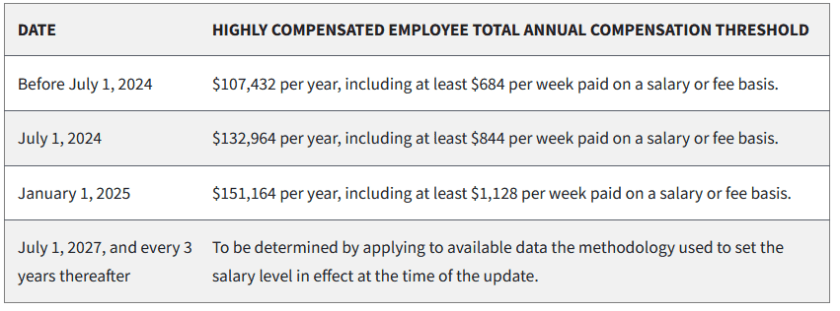
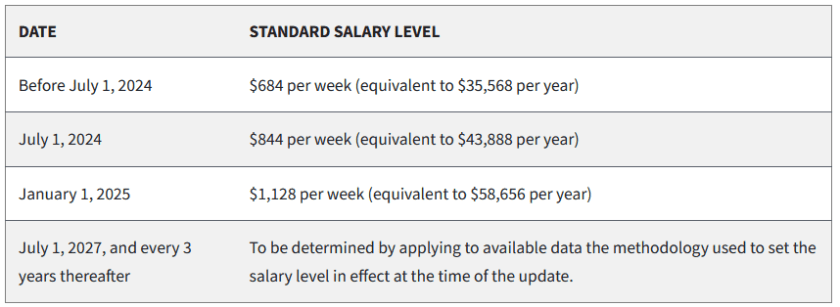
As a result of the court’s ruling, the standard salary level for the FLSA’s white collar exemptions will return to the pre-rule amount of $684 per week ($35,568 per year). The court also vacated the rule’s increased salary threshold for the FLSA’s highly compensated employee exemption, which will now remain at $107,432.

Since change often creates uncertainty, employers should carry Employment Practices Liability Insurance that includes limited wage & hour coverage. Please contact us if you would like to learn more about employment practices liability insurance.

Employers receiving medical loss ratio (MLR) rebates must proceed cautiously

By Anita Byer

The Affordable Care Act’s Medical Loss Ratio (MLR) is designed to hold health insurance companies accountable and keep consumer costs down. According to KFF, nearly $12 billion in rebates have been issued since the MLR took effect in 2012. Approximately $1.1 billion more in rebates will be issued in 2024. Employers receiving MLR rebates, which are generally distributed by September 30th, must proceed cautiously to avoid serious ERISA violations.

The MLR generally requires group health insurers to spend at least 80% (or 85% for large groups) of premium income on health care costs and quality improvement activities. The other 20% (or 15%) can go to overhead expenses and profits. Group health insurers that fail to satisfy the ACA’s medical loss ratio (or 80/20 rule) are required to rebate a portion of the premiums paid by policyholders.

There are specific rules governing MLR rebates. The first step is to determine whether the employer or plan participants are entitled to the rebate, which depends on whether all or part of the rebate is considered a plan asset under ERISA. Any part of the rebate that is considered a plan asset must be used by the employer, in its fiduciary capacity, solely for the benefit of the plan. Conversely, the employer is entitled to retain any part of the rebate that is not considered a plan asset.

According to the Department of Labor, in the absence of direct evidence to the contrary, like specific language in plan documents, rebates should generally be allocated between the employer and plan participants based on their relative premium contributions.

  • Employer Pays 100%:  Employer may retain the entire rebate because it is not a plan asset
  • Participants Pay 100%:  The entire rebate is a plan asset that must be used solely for the benefit of the plan
  • Each Pay Fixed Percentage:  Each are entitled to portion of rebate commensurate with the portion of the premium each paid
  • Employer Pays Fixed Amount and Participants Pay Additional Costs:  The total amount paid by participants must be allocated as a plan asset for their benefit, and any remaining amount may be retained by the employer


After determining how much of the rebate must be used to benefit participants (because it is considered a plan asset under the DOL’s guidance), the next step is distributing the rebate. Employers must use the amount of the rebate that is proportionate to the total amount of premium paid by all employees under the policy, for the benefit of such employees in a manner that is reasonable, fair, and objective. According to the DOL, employers may:

  • Reduce employees’ portion of premium for the subsequent policy year for all employees covered (at the time the rebate is received) under any option offered under a group health plan.
  • Reduce employees’ portion of premium for the subsequent policy year for employees covered (at the time the rebate is received) under the specific plan option for which the rebate was issued.
  • Give a cash refund to employees enrolled (at the time the rebate is received) in the group health plan option for which the rebate was issued.


The regulations provide that premiums reductions or cash refunds may, at the option of the employer: 1) be divided evenly among employees; 2) be divided based on each employee’s actual premium contributions; or 3) apportioned in a manner that reasonably reflects each employee’s premium contributions. Employers must generally do this within three months of receiving the rebate.

Dealing with MLR rebates can be risky and time consuming because they are governed by complex laws and regulations. Consultation with legal, insurance, and accounting professionals may be necessary to avoid potentially costly ERISA violations. If you have any other questions, please contact us.

DOL issues final rule raising minimum salary threshold for FLSA’s “white collar” exemptions

By Anita Byer, Setnor Byer Insurance & Risk

The Department of Labor issued a final rule that will make it more expensive for employers to keep overtime-exempt employees on the payroll. On April 26, 2024, the DOL published a final rule that increases the minimum salary that executive, administrative and professional employees must be paid to be exempt from the Fair Labor Standards Act’s overtime pay requirements. The final rule also increases the total annual compensation threshold for the FLSA’s highly compensated employee (HCE) exemption. According to the DOL, in the first year after implementation of the final rule, approximately 4 million workers will either become eligible for overtime pay or have their salary increased.

The current standard salary level for the FLSA’s white collar exemptions is $684 per week ($35,568 per year). Under the final rule, on July 1, 2024, the standard salary level will increase to $844 per week ($43,888 per year). On January 1, 2025, it will increase again to $1,128 per week ($58,656 per year). On July 1, 2027, and every three years thereafter, the standard salary level will be updated by applying current earnings data to the final rule’s salary methodology. (The DOL will publish a notice announcing the updated salary level amount at least 150 days before the update takes effect.)

The final rule also increased the salary threshold used to determine whether a worker qualifies for the FLSA’s HCE exemption. On July 1, 2024, the annual compensation level needed to be an exempt HCE will increase from $107,432 to $132,964. On January 1, 2025, the annual compensation level will increase to $151,164. On July 1, 2027, and every three years thereafter, the HCE total annual compensation threshold will be updated by applying current earnings data to the final rule’s salary methodology. (The DOL will publish a notice announcing the updated salary level amount at least 150 days before the update takes effect.)

According to the DOL, in addition to expanding overtime protections to lower-paid salaried workers, the final rule ensures predictability. Regularly updating salary threshold to reflect changes in earnings protects against the future erosion of overtime protections. It is worth noting that the final rule, or parts of it, are likely to face legal challenges from those opposing its implementation. As a result, the final rule’s effective date may be extended, perhaps indefinitely.

Click here to read the published final rule. Click here for additional information from the Department of Labor. Since change often creates uncertainty, employers should carry Employment Practices Liability Insurance that includes limited wage & hour coverage. Please contact us if you would like to learn more about employment practices liability insurance.

EEOC publishes final rule on Pregnant Workers Fairness Act

By Anita Byer, Setnor Byer Insurance & Risk

The Equal Employment Opportunity Commission recently issued a final rule to implement the Pregnant Workers Fairness Act (PWFA). The PWFA generally requires covered employers to reasonably accommodate a qualified employee’s or applicant’s known limitations related to, affected by, or arising out of pregnancy, childbirth, or related medical conditions, unless doing so will cause the employer an undue hardship. The PWFA, which went into effect June 27, 2023, generally applies to private employers and public sector employers that have 15 or more employees.

According to the EEOC, the final rule and interpretive guidance provide clarity to employers and employees (including applicants) about their respective rights and responsibilities under the PWFA. This is accomplished, in part, with detailed definitions and examples. Below are some key requirements and provisions of the PWFA and the final rule that employers must know to avoid violations.

Under the PWFA, a covered employer may not:

  • Fail to make a reasonable accommodation for the known limitations of a qualified employee, unless the accommodation would cause an undue hardship.
  • Require a qualified employee to accept an accommodation other than a reasonable accommodation arrived at through the interactive process.
  • Deny a job or other employment opportunities to a qualified employee or applicant based on the person’s need for a reasonable accommodation.
  • Require a qualified employee to take leave if another reasonable accommodation can be provided that would let the employee keep working.
  • Punish or retaliate against an employee or applicant for requesting a reasonable accommodation, opposing unlawful discrimination or participating in a PWFA proceeding.
  • Coerce individuals who are exercising their rights or helping others exercise their rights under the PWFA.


It is important to note that the PWFA applies only to accommodations. Claims of discrimination based on pregnancy, childbirth, or related medical conditions must be pursued under other laws prohibiting pregnancy-related discrimination, such as Title VII or the Americans with Disabilities Act. A reasonable accommodation is a change in the work environment or the way things are usually done at work. The final rule provides various examples, such as frequent breaks, telework, light duty, permitting employees to sit or stand, temporarily suspending one or more essential functions, and adjusting or modifying policies.

Significantly, the final rule identifies four simple modifications that will almost always be considered reasonable accommodations that do not impose an undue hardship when requested by a pregnant employee. These “predictable assessments” essentially require employers to allow pregnant employees to do the following, as needed:

  • carry or keep water nearby to drink;
  • take additional restroom breaks;
  • sit or stand during work; and
  • take breaks to eat and drink.


An employee or applicant who can perform the essential functions of the job with or without a reasonable accommodation is considered qualified under the PWFA. An employee can also be considered qualified if their inability to perform the essential job functions is temporary, the employee could perform the functions in the near future, and the inability to perform the essential functions can be reasonably accommodated. This, according to the EEOC, means that an employee who is temporarily unable to perform essential job functions may require light duty or a change in work assignments as a reasonable accommodation under PWFA.

Under the final rule, an employee requesting a reasonable accommodation must identify the limitation (the physical or mental condition related to, affected by, or arising out of pregnancy, childbirth, or related medical conditions) and that the employee needs an adjustment or change at work due to the limitation. Once the employer knows, it should engage in the interactive process with the employee or applicant to discuss the known limitation and the adjustment or change needed at work.

When considering reasonable accommodations under PWFA, the EEOC urges employers to keep the following tips in mind.

  • Train supervisors about the PWFA as they are particularly likely to receive accommodation requests.
  • Workers do not need to use specific words to request an accommodation. Once an employee requests an accommodation, employers must use the interactive process.
  • Limitations may be minor and may be associated with an uncomplicated pregnancy and may require accommodations that are easy to make.
  • A worker may need different accommodations as the pregnancy progresses, they recover from childbirth, or the related medical condition improves or gets worse.


Additional information about pregnancy-related discrimination is available from the EEOC.

Employers should carry Employment Practices Liability Insurance to protect against mistakes that are more likely to result from the confusion that always seems to accompany regulatory rule changes. Please contact us to learn more about EPLI coverage.

EEOC’s latest performance report highlights risk of employment-related lawsuits

By Anita Byer, Setnor Byer Insurance & Risk

The Equal Employment Opportunity Commission recently released its performance report for fiscal year 2023, which ended September 30, 2023. The EEOC is responsible for enforcing various federal equal employment opportunity laws. According to the EEOC, “the agency’s performance during FY 2023 reflects both an increased demand for its services and significant remedies for workers who suffered discrimination.” The data contained in its annual performance report can be used to better understand various employment-related liability exposures that continue to pose a significant risk to most employers.

In 2023, the EEOC experienced an increased demand for services from the public. It received 81,055 new discrimination charges, which is a 10% increase compared to fiscal year 2022. The EEOC also handled more than 522,132 calls and 86,008 emails from the public, representing respective increases of 10% and 25%. Yet, despite the increased workload, the EEOC managed to secure more than $665 million for victims of discrimination, including approximately:

  • $440 million for 15,143 victims of employment discrimination through mediation, conciliation, and settlements;
  • $22 million for 968 individuals in litigation;
  • $202 million for 5,943 federal employees and applicants.


The EEOC also filed 143 merits lawsuits in fiscal year 2023, the most since 2019. Merits lawsuits are direct suits or interventions alleging violations of the substantive provisions of the statutes enforced by the EEOC and suits to enforce administrative settlements. It is worth noting that the EEOC also strengthened its enforcement capabilities by filling nearly 500 new positions during fiscal year 2023, most of which are front-line staff, including investigators, mediators, and attorneys.

The lawsuits filed by the EEOC in fiscal year 2023 include 86 suits seeking relief for individuals, 32 non-systemic suits with multiple victims, and 25 systemic suits. These lawsuits alleged violations covering multiple bases, including retaliation (56), sex (50), disability (43), race (24), age (12), religion (10), and national origin (8). The issues raised most frequently in these suits were discharge (65), reasonable accommodation (43), hiring (including referral, recall, assignment, and job classification) (36), constructive discharge (34), and harassment (34).

In addition to its enforcement operations, the EEOC also made significant efforts to prevent employment discrimination and advance equal employment opportunities through education and outreach, including:

  • Conducting 3,318 in-person and virtual no cost outreach and fee-based training events for 314,199 individuals nationwide.
  • Increasing outreach to vulnerable workers and developing and enhancing partnerships with organizations that work with vulnerable workers.
  • Launching social media campaigns to provide members of the public greater access to information about their rights and responsibilities.
  • Increasing digital media products to enhance the public’s understanding of their rights and responsibilities under federal equal employment opportunity laws. As a result, the EEOC’s website had more than 12 million users (11% increase) and over 31.7 million page views (9.3% increase) in fiscal year 2023.


Employers can use the EEOC’s latest performance report to protect against employment-related liabilities. After all, it is much easier to avoid costly violations when you know where the EEOC is directing its attention and how it is allocating resources. However, given today’s rapidly changing environment, employers also need employment practices liability insurance (EPLI) because it is impossible to know what tomorrow may bring.

Please contact us to learn more about protecting your business with Employment Practices Liability Insurance.

DOL issues final rule for determining independent contractor status

By Anita Byer, Setnor Byer Insurance & Risk

On January 10, 2024, the Department of Labor published a final rule for determining independent contractor status under the Fair Labor Standards Act. This rule seeks to combat employee misclassification, which according to the DOL, “is a serious issue that deprives workers of basic rights and protections.” The final rule rescinds the 2021 Independent Contractor Rule and restores the totality-of-the-circumstances economic reality test, under which no single factor or group of factors is assigned any predetermined weight. It becomes effective March 11, 2024.

Correctly classifying workers as employees or independent contractors is crucial for businesses. It can affect a worker’s rights to minimum wage and overtime pay and an employer’s liability for failing to pay lawful wages. Unfortunately, the correct classification is not always obvious and misclassifications can be costly.

Under the final rule, a worker is not an independent contractor if they are, as matter of economic reality, economically dependent on an employer for work. The rule applies the following six factors to analyze employee or independent contractor status under the FLSA:

  1. opportunity for profit or loss depending on managerial skill;
  2. investments by the worker and the potential employer;
  3. degree of permanence of the work relationship;
  4. nature and degree of control;
  5. extent to which the work performed is an integral part of the potential employer’s business; and
  6. skill and initiative.


No factor or set of factors among this list has a predetermined weight. Additional factors may also be relevant if such factors in some way indicate whether the worker is in business for themself (i.e., an independent contractor), as opposed to being economically dependent on the employer for work (i.e., an employee under the FLSA).

How does this final rule differ from the 2021 Independent Contractor Rule? In addition to restoring the totality-of-the-circumstances economic reality test, where no single factor or group of factors is assigned any predetermined weight, the final rule:

  • considers six factors, instead of five, including the investments made by the worker and the potential employer;
  • provides additional analysis of the control factor, including a detailed discussion of how scheduling, supervision, price-setting, and the ability to work for others should be considered when analyzing the nature and degree of control over a worker; and
  • returns to the DOL’s longstanding consideration of whether the work is integral to the employer’s business (rather than whether it is exclusively part of an “integrated unit of production”).


Despite (or because of) the new final rule, difficulty and uncertainty surrounding independent contractor classifications is likely to continue for some time. Unfortunately, different circumstances can affect the relevancy of any specific factor, which makes it nearly impossible to adopt a one-size-fits-all approach to making this determination. Employers should carry Employment Practices Liability Insurance to protect against mistakes that are more likely to result from the confusion that always seems to accompany regulatory rule changes. Please contact us to learn more about EPLI coverage.

Does workers’ compensation cover employees injured at company-sponsored events?

By Anita Byer, Setnor Byer Insurance & Risk

Company-sponsored social and recreational events have become common in today’s workplace. They can be a great way to recognize achievements, celebrate holidays, strengthen bonds, build moral or just let off some steam. But what happens if an employee is injured while attending a company-sponsored event? Is the injury covered under their employer’s workers’ compensation policy? Well, that depends.

Workers’ compensation insurance generally covers injuries that arise out of and in the course and scope of employment. However, depending on the circumstances, injuries sustained by employees attending company-sponsored social or recreational activities may be covered by workers’ compensation. This determination can be both state- and fact-specific, with each state applying its own interpretation of whether injuries “arise out of and in the course of employment” when they occur at a company-sponsored social or recreational event.

In Florida, for example, “recreational or social activities are not compensable unless such recreational or social activities are an expressly required incident of employment and produce a substantial direct benefit to the employer beyond improvement in employee health and morale that is common to all kinds of recreation and social life.” Under this standard, issues of compensability often turn on whether the employee’s attendance at the company-sponsored event was truly voluntary.

An injury sustained at a company-sponsored event will likely be deemed employment-related (and covered by workers’ compensation) if attendance is mandatory. Attendance at a “voluntary” event may also be considered mandatory if employees feel forced to attend. A company-sponsored event is not truly voluntary if attendees are rewarded or absentees are punished.

It should also be noted that the employer need not actually “host” the event for liability to be imposed.  For example, if employees are required to attend an event sponsored by a customer, they are likely covered by workers’ compensation because the employer made attendance mandatory hoping to benefit from the goodwill generated by the staff toward the customer.

Generally, employer-sponsored picnics, sports events, recreational leagues, and company retreats are meant to foster team building, inspire loyalty, and boost employee morale. Such events are usually well-received by employees and may serve as a reward for hard work.  However, employers would be wise to consider the potential risks involved when planning these events. To minimize exposure, employers should:

  • make clear to employees that attendance and participation are not mandatory; and
  • when possible, plan events away from the company premises and on weekends to emphasize that such events are social and not work-related.

When these and other appropriate risk-management measures are taken, employers can maximize the benefits of company-sponsored while minimizing the risk of compensable workers’ compensation claims. Please contact us if you have questions about Worker’s Compensation and Employers Liability Insurance Coverage.

FTC proposes ban on non-compete clauses for employees

By Anita Byer, Setnor Byer Insurance & Risk

The Federal Trade Commission recently proposed a new rule that would ban the use of non-compete clauses in employment agreements. The FTC believes that the widespread use of non-compete clauses suppresses wages, hampers innovation and stifles entrepreneurship. According to FTC estimates, the proposed rule could increase wages by nearly $300 billion per year and expand career opportunities for millions of Americans. It could also cause inconvenience, disruption and even financial harm to countless individuals and businesses nationwide. A watershed moment indeed, but for better or worse?

Under the proposed rule, the use of non-compete clauses would be considered an unfair method of competition. As such, it would be unlawful for an employer to:

  • enter into or attempt to enter into a non-compete clause with a worker;
  • maintain a non-compete clause with a worker; or
  • represent to a worker, under certain circumstances, that the worker is subject to a non-compete clause.

The notable breadth of the proposed rule comes from its definitions. “Worker” is defined broadly to mean any natural person who works for an employer, whether paid or unpaid, including employees, independent contractors, interns and volunteers. A “non-compete clause” is any contractual term between an employer and a worker that prevents the worker from seeking or accepting employment, or operating a business, after the conclusion of the worker’s employment with the employer. This already broad definition is made even broader by including de facto non-compete clauses.

A de facto non-compete clause is any contractual term that has the effect of prohibiting a worker from seeking or accepting employment or operating a business after the conclusion of the worker’s employment with the employer. A non-disclosure agreement, for example, could be considered a de facto non-compete clauses if it is written so broadly that it effectively precludes the worker from working elsewhere in the same field. If the proposed rule is adopted, this functional test to determine whether a contractual term should be interpreted as a prohibited non-compete clause seems to be fertile ground for litigation.

So, what happens to existing non-compete clauses under the proposed rule? If adopted as is, the rule would require employers to rescind existing non-compete clauses with workers and actively inform their employees that the contracts are no longer in effect. The rule, however, does have a limited sale-of-business exception that allows a person who owns at least 25 percent of a business entity to execute a non-compete clause as part of a sales transaction.

It’s important to note that this is not a final rule. If and when the FTC publishes a final rule, it may be substantially different than the proposed rule. However, since any such rule could have potentially significant implications, employers should be paying attention to the FTC and its desire to essentially prohibit the use of non-compete clauses. Those not comfortable taking the wait-and-see approach are free to participate in the rule-making process. The FTC is accepting public comments on the proposed rule through March 10, 2023. So, what do you think? Should non-compete clauses be banned?

If adopted, the proposed rule would supersede any inconsistent state statute, regulation, order or interpretation, altering the nature employer / employee relationships nationwide. Please contact us to discuss the value of having Employment Practices Liability insurance coverage in this rapidly changing regulatory environment.

EEOC releases new “Know Your Rights” poster; replaces “EEO is the Law” poster

By Anita Byer, Setnor Byer Insurance & Risk

At a glance…

  • The EEOC released a new mandatory workplace poster – Know Your Rights: Workplace Discrimination is Illegal – to replace the previous EEO is the Law poster.
  • The new poster includes various changes, including the addition of a QR code for fast digital access to the EEOC’s file a charge webpage.
  • Most private employers are required to post the new poster in a conspicuous place upon its premises where notices to employees and applicants are customarily maintained.
  • Download Know Your Rights: Workplace Discrimination is Illegal and post it now.

The Equal Employment Opportunity Commission released a new mandatory workplace poster entitled Know Your Rights: Workplace Discrimination is Illegal. This new poster was created to update and replace the ubiquitous EEO is the Law poster. Not familiar with this poster? Check the bulletin board in your employee break room and look behind the ancient flyers for garage sales and guitar lessons. Once you find it, take it down and replace it with the new poster. Because the Know Your Rights poster, like its predecessor, must be prominently displayed in most private workplaces.

Every covered employer is required to conspicuously post the new Know Your Rights poster upon its premises. This includes every employer covered by Title VII of the Civil Rights Act, the Americans with Disabilities Act or the Genetic Information Nondiscrimination Act. The poster summarizes various laws enforced by the EEOC and includes information about discrimination based on:

  • race, color, sex (including pregnancy and related conditions, sexual orientation, gender identity), national origin, religion;
  • age (40 and older);
  • equal pay;
  • disability and genetic information; and
  • retaliation.

The Know Your Rights poster includes a number of changes designed to make it easier for employers to understand their legal responsibilities and for workers to understand their legal rights and how to contact EEOC for assistance. The new poster:

  • uses straightforward language and formatting;
  • notes that harassment is a prohibited form of discrimination;
  • clarifies that sex discrimination includes discrimination based on pregnancy and related conditions, sexual orientation or gender identity;
  • adds a QR code for fast digital access to the how to file a charge webpage; and
  • provides information about equal pay discrimination for federal contractors.

The Know Your Rights poster must be posted in a conspicuous place where notices to applicants and employees are customarily posted. In addition to physically posting, the EEOC encourages covered employers to conspicuously post the notice digitally on their website. In most cases, electronic posting supplements the physical posting requirement. However, for employers without a physical location or employees working remotely, it may be the only posting.

Finally, be sure to use the correct version of the new poster, which you can download here. The following notice was posted on the EEOC’s website. “Employers, please note a new version of the “Know Your Rights: Workplace Discrimination is Illegal” poster has replaced and supersedes a version uploaded on 10/19. Please use the version marked “(Revised 10/20/2022)” going forward. We apologize for any inconvenience.”

Failing to post the Know Your Rights poster as required may result in a fine (adjusted for inflation) that is currently up to $612 per offense. To protect against costly employment-related claims, employers should have a policy prohibiting workplace discrimination and harassment. Managers and employees should be trained to prevent and avoid unlawful behavior. Employment Practices Liability Insurance is also needed to cover the high cost of defending actual and alleged claims of unlawful conduct.

Please contact us to learn more about EPLI coverage.
DOL proposes new rule for determining independent contractor status…again

By Anita Byer, Setnor Byer Insurance & Risk

At a glance…

  • The Department of Labor is proposing a new rule to determine whether a worker is an employee or an independent contractor under the Fair Labor Standards Act.
  • The proposed rule rescinds the 2021 Independent Contractor Rule and restores the multifactor, totality-of-the-circumstances analysis to determine independent contractor status under the FLSA.
  • According to the DOL, the proposed rule is more consistent with longstanding judicial precedent and will provide consistency for employers.
  • The proposed rule, if finalized, would likely increase the number of workers who would be considered employees under the FLSA.
  • The DOL extended the deadline to submit comments on the proposed rule to December 13, 2022. Substantial opposition to the proposed rule is expected.

The Department of Labor is proposing a new rule for determining independent contractor status under the Fair Labor Standards Act. This is significant because correctly classifying workers as employees or independent contractors is crucial for businesses. The correct classification isn’t always obvious and misclassifications can be costly. Unfortunately, the rules for determining independent contractor status lack uniformity and have recently become increasingly inconsistent and uncertain. Time will tell whether the new proposed rule will fix the problem, or just extend it.

According to the DOL, the proposed rule adopts a framework more consistent with longstanding judicial precedent under the FLSA. The DOL believes that the new rule preserves essential worker rights and provides consistency for employers and businesses. To that end, the proposed rule:

  • Aligns the DOL’s approach with courts’ FLSA interpretation and the economic reality test.
  • Restores the multifactor, totality-of-the-circumstances analysis to determine whether a worker is an employee or an independent contractor under the FLSA.
  • Ensures all factors are analyzed without assigning a predetermined weight to a particular factor or set of factors.
  • Reverts to the longstanding interpretation of the economic reality factors.
  • Rescinds the 2021 Independent Contractor Rule.

The proposed rule focuses on the economic realities of the worker’s relationship with the employer. A worker is an independent contractor if the worker is, as a matter of economic reality, in business for themself. Six factors must be considered to determine the economic realities of the working relationship and the question of economic dependence.

  1. Opportunity for profit or loss depending on managerial skill.
  2. Investments by the worker and the employer.
  3. Degree of permanence of the work relationship.
  4. Nature and degree of control.
  5. Extent to which the work performed is an integral part of the employer’s business.
  6. Skill and initiative.

No one factor or subset of factors is necessarily dispositive, and the weight given each factor may depend on specific facts and circumstances. Moreover, these six factors are not exhaustive. Additional factors may be considered relevant under some circumstances. Unfortunately, different circumstances can affect the relevancy of any specific factor, so it’s nearly impossible to adopt a one-size-fits-all approach to making this determination.

Despite (or because of) the DOL’s new proposed rule, the difficulty and uncertainty surrounding independent contractor classifications is likely to continue. Employers should carry Employment Practices Liability Insurance to protect against mistakes that are more likely to result from the confusion that always seems to accompany proposed regulatory changes. Please contact us to learn more about EPLI coverage.