Hurricane season 2023 is nearly underway, start preparing today

By Anita Byer, Setnor Byer Insurance & Risk

Hurricane season 2023 is nearly underway, so it’s time to start preparing…today. Perfect timing too, because the first week of May is Hurricane Preparedness Week. The National Oceanic and Atmospheric Administration sponsors this week to raise awareness of the hazards posed by tropical storms and hurricanes. As the frequency and severity of storms increase, so too does the importance of preparation. Hurricane season 2023 begins June 1st. Are you prepared?

If not, NOAA offers the following tips to help you get started.

Know your risk (water and wind). Find out what types of storm-related wind and water hazards exist where you live. Hurricanes are not just a coastal problem. Dangerous and destructive winds can make their way hundreds of miles inland. Damaging waters can also extend well beyond the coastline, flooding areas indiscriminately, regardless of flood zone designation. Those living in unsound structures or flood-prone areas must know in advance if it is safe to stay home during a storm.

Develop an evacuation plan. Where will your family go if you are ordered to evacuate? Know your hurricane evacuation zone and develop an evacuation plan that specifies where to go and how to get there. Don’t forget your pets! They may not be allowed in shelters and hotels, so find suitable accommodations now so they don’t get left behind.

Assemble disaster supplies. Whether you’re evacuating or sheltering-in-place, you will need sufficient supplies to get through the storm and its potentially lengthy aftermath. Have enough non-perishable food, water and medicine to last each person in your family a minimum of 3 days (longer, if possible). Remember to get gas, cash, batteries and flashlights. Consider a portable crank or solar-powered USB charger for cell phones. Gas tanks should be kept at least half full (EV batteries charged at least 50% – 80%) throughout hurricane season.

Strengthen your home. Make sure your home is ready to withstand the wind, rain and flooding a hurricane can bring. Check to see if your home meets building code specifications. Consider retrofits, many of which are not as costly or time consuming as you may think. Renters should work with their landlord to prepare for a storm.

Help your neighbors. Talk to your neighbors about their hurricane plans and preparations. Discuss how you can help one another prepare before a storm and rebuild after.

Have a written plan. Preparing a written plan can help identify your family’s unique needs and understand what must be done to protect those you love during a storm. Write down your hurricane plan and make sure everyone in your household knows and understands it.

Get an insurance check-up. NOAA stresses the importance of insurance, particularly during hurricane season. Make sure you have enough insurance to repair or replace your home, car and any other property that might be damaged during a storm. Don’t forget about insurance for your business. Remember, standard policies do not cover flooding, so you will need a separate flood insurance policy for your home and business.

It only takes one storm to make it an active hurricane season for you. Take advantage of Hurricane Preparedness Week. Start preparing before the lines grow long and supplies run short. Contact our team of experienced and responsive insurance and risk management professionals to find affordable options to protect your home and your business in the event of a hurricane.
Florida passes sweeping reforms to fix crumbling property insurance market

By Anita Byer, Setnor Byer Insurance & Risk

Florida lawmakers just passed sweeping property insurance reforms to repair the state’s crumbling property insurance market. The Florida Legislature convened a second special legislative session in mid-December to address the current property insurance crisis. While significant reforms were passed during the first special session, they aren’t nearly as bold or consequential as the reform bill passed during the second, which was promptly approved by Governor DeSantis.

The bill contains comprehensive reforms intended to ensure Floridians have access to quality, affordable private market property insurance. The reforms, like the problems that prompted them, are wide-ranging and far-reaching. Many are significant. Some are unprecedented. Let’s review some of the bill’s key provisions.

Claims filing deadline. The bill reduces the amount of time policyholders have to file or reopen a property insurance claim from two years to one year. The time to file a supplemental claim is reduced from three years to 18 months.

Prompt pay laws. The bill amends Florida’s prompt pay laws to encourage the prompt payment of claims by:

  • reducing the time for insurers to pay or deny a claim from 90 to 60 days;
  • reducing the time for insurers to review and acknowledge claim communications from 14 to 7 days;
  • reducing the time for insurers to begin an investigation from 14 to 7 days;
  • reducing the time to conduct physical inspections from 45 to 30 days;
  • permitting insurers to use electronic methods to investigate losses and communicate with policyholders; and
  • requiring insurers to send an adjuster’s loss estimate to policyholders within 7 days after it is created.

Awards of attorney fees in litigation involving property insurance policies. The bill seeks to reduce frivolous litigation arising from residential and commercial property insurance policies by:

  • eliminating various one-way attorney fee provisions throughout the insurance code for suits arising from property insurance policies;
  • making the civil offer of judgment statute applicable to suits arising from property insurance policies;
  • allowing joint offers of settlement that are contingent on acceptance of all joint offerees; and
  • removing provisions regarding attorney fees relative to the alternative procedure for resolution of disputed sinkhole insurance claims.

Assignments of benefits (AOBs). The bill prohibits any assignment of any post-loss insurance benefit under any residential or commercial property insurance policy issued on or after January 1, 2023.

Bad faith failure to settle actions against property insurers. The bill provides that bad faith litigation for failure to settle a property insurance claim may not be filed until after the insured has established through adverse adjudication by a court that the insurer breached the insurance contract and a final judgment or decree has been rendered against the insurer.

Flood insurance notice. The bill amends the mandatory flood insurance notice by requiring it to be part of the declarations page and makes revisions to the content of notice to encourage purchase of flood insurance.

Arbitration. The bill allows insurers to offer (but not require) policies that include a mandatory binding arbitration clause. Insurers must also provide an appropriate premium discount in exchange for the rights given up by the policyholder.

Citizens Property Insurance Corporation (Citizens). The bill:

  • Increases Citizens’ renewal eligibility threshold for personal lines policyholders to make them ineligible for renewal with Citizens upon receiving an offer of comparable coverage from an authorized insurer for a premium that is not more than 20 percent greater than Citizens’ renewal premium.
  • Increases Citizens’ eligibility threshold for new commercial residential policies from 15 to 20 percent.
  • Requires that rates charged by Citizens be actuarially sound and non-competitive with the approved rates charged in the admitted market.
  • Increases the potential rates charged for property that is not a primary residence.
  • Repeals language allowing policyholders to return to Citizens as a renewal if the take-out carrier increases their rates above the Citizens’ glidepath.
  • Requires personal lines residential policyholders to have qualifying flood insurance to be eligible for coverage.

These, and other provisions within the bill, can fairly be described as the most significant property insurance reforms in recent history, but their effectiveness remains to be seen. Will they strengthen Florida’s property insurance market? Will Floridians soon see more options and lower prices? We certainly hope so, but only time will tell. In the meantime, our team is available to discuss how these reforms may affect your personal and commercial property insurance coverages.

Florida’s Property Insurance Crisis: Facts Behind the Myths

By Anita Byer, Setnor Byer Insurance & Risk

Florida’s property insurance market is in the midst of a crisis. According to the Insurance Information Institute, Florida’s domestic property insurers had net underwriting losses of more than $1 billion in both 2020 and 2021. In 2022, an unprecedented six insurance companies were forced into liquidation due to insolvency. Add to this the fact that a number of Florida’s property insurers are steadily reducing their exposure by writing fewer and more restrictive property insurance policies. To make matters worse, insurers are currently inundated with claims caused by Hurricane Ian, which is expected to be the costliest natural disaster in Florida’s history at a price tag of $50 billion, according to Corelogic. So, what does the future hold for the millions of Floridians who need property insurance? Fewer choices and higher premiums. We cannot continue down this path. Florida’s property insurance market must be fixed to prevent this crisis from becoming a catastrophe.

While the news may seem grim, and the future of the Florida insurance marketplace in question, it is possible to return the property insurance marketplace to profitability, which will also allow insurers to reduce premiums to affordable levels despite the 1350 miles of coastline exposure to high winds and flooding. But the system is in dire need of change, and this change will require commitment and compromise from all stakeholders, including insurers, insureds, lawyers and lawmakers.

In December, we will all be witness to, yet, another attempt by the legislature to repair what many refer to, in part, as a man-made insurance crisis brought about by fraud, inflated claims, litigation abuse, misguided government policies and some insurer mismanagement on claims settlement matters. To this, we need to seriously consider the implications of a Hurricane Andrew type event making landfall on the southeast coast of Florida and the estimated $72 billion insured loss price tag that will come with such an event.

The insured loss numbers are staggering, so it is critical to address the waste within the system so that all possible dollars are deployed for recovery, efficiently and fairly, and domestic property insurers returned to profitability. And, whether one considers insurance companies friend or foe, 2022 claims litigation expenses are more than double that of 2016, with over $3 billion, annually, spent by insurers for defense costs and containment, as reported by the Office of Insurance Regulation (OIR).  More sobering news from the OIR details that while Florida accounts for approximately 7% of all homeowners’ claims filed in the country, these claims account for nearly 80% of all countrywide litigation. Along with this data, it should be noted that business organizations across the state report that a majority of the excess costs built into the system never find their way to the rightful beneficiary — the insured.

Another important element to consider when looking at the property insurance crisis, is the dominance of Citizens, which has grown to insure over 1 million policies, largely in the southeast. It is the position of the business-leaning legislators that a state subsidized entity should not compete with private enterprise, and that Citizens needs to return to its original mission of being an insurer of ‘last resort.’ Citizens, with its actuarially unsound (suppressed) pricing, will shortly become the insurer of choice for many residents unless pricing more closely resembles the private marketplace. And, while many insureds may find that Citizens offers pricing at more affordable levels than the private marketplace, and would be reluctant to support legislation that requires Citizens to charge ‘sound’ rates, it should be noted that any financial deficits of Citizens following a storm will cause unheard of additional costs to insureds through a required assessment of up to 75%.

While a handful of legislators and insiders are in general agreement on how to address the waste and inefficiencies in the system, and are prepared to move forward with draft legislation, experts will tell you that the ultimate fix needs to include: laws that are fair and balanced; a robust consumer protection element for unjust claims settlements; temporary financial support from the state IF insurers are unable to secure affordable reinsurance at primary levels in 2023; and a fix to Citizens’ underwriting and pricing structure, so that the private marketplace can thrive. Most importantly, Florida needs to make changes to claims settlement matters that disincentivize wasteful litigation brought by plaintiff attorneys and keeps insurers accountable.

Without the inflationary claims defense costs baked into the system and the full burden of primary reinsurance costs that are expected to increase significantly, insurers will have a fighting chance to survive and offer Floridians property insurance at lower costs and with more favorable policy terms and conditions, eventually and hopefully.

Risk of residential fire more than doubles on Thanksgiving

By Anita Byer, Setnor Byer Insurance & Risk

Did you know that the risk of a residential fire more than doubles on Thanksgiving Day? In fact, …

  • The average number of residential fires is 2.3 times higher on Thanksgiving than all other days of the year.
  • Cooking is the leading cause of all Thanksgiving fires (74 percent).
  • More than half of all Thanksgiving fires (54 percent) occurred from 10 a.m. to 5 p.m.
  • Most Thanksgiving fires (60 percent) happen in 1- and 2-family dwellings.

The good news is that it’s pretty easy to effectively reduce to risk of a Thanksgiving fire in your home. Here are ten tips from FEMA to help keep your family and friends safe this year.

  1. Stand by your pan. If you leave the kitchen, turn the burner off.
  2. Keep an eye on what you fry. Most cooking fires start when frying food.
  3. Roll up your sleeves. This reduces the chance that they’ll catch fire.
  4. Supervise children and pets. Make sure they stay away from the stove.
  5. Watch what you’re cooking. If you see smoke, or grease starts to boil, turn the burner off.
  6. If there’s an oven fire, keep the door closed. Turn off the oven and keep the door closed until it’s cool.
  7. Move things that can burn away from the stove. This includes dishtowels, bags, boxes, paper and curtains.
  8. Turn pot handles toward the back of the stove. This makes it harder to bump them or pull them over.
  9. Only use a turkey fryer outdoors. Place it on a sturdy surface, away from things that can burn.
  10. Check smoke alarms. Working smoke alarms should be close to where anyone may be sleeping.

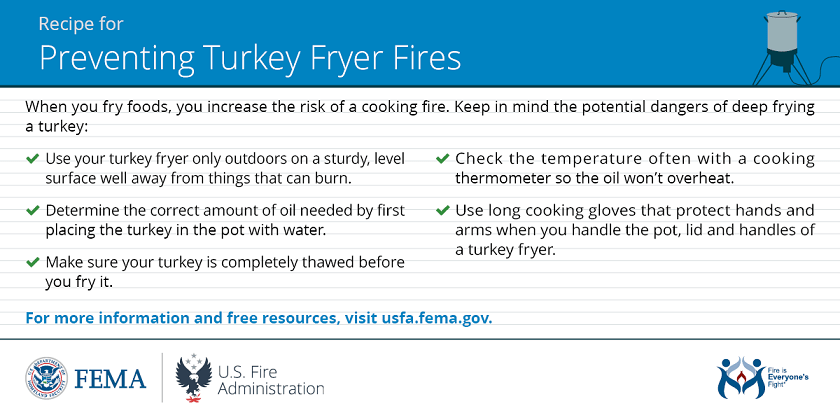
FEMA also offers the following “recipe” for preventing turkey fryer fires.

Happy Thanksgiving!

NOAA updates 2022 hurricane forecast; above-normal activity still expected

By Anita Byer, Setnor Byer Insurance & Risk

The National Oceanic and Atmospheric Administration recently updated its 2022 Atlantic hurricane season outlook. Despite relatively little storm activity so far, NOAA maintains that atmospheric and oceanic conditions still favor an above-normal 2022 hurricane season. “We’re just getting into the peak months of August through October for hurricane development,” cautions NOAA Administrator Rick Spinrad, Ph.D., “and we anticipate that more storms are on the way.” In other words, stay prepared and don’t let your guard down just yet.

NOAA initially forecast a 65 percent chance of an above-normal season, a 25 percent chance of a near-normal season and a 10 percent chance of a below-normal season. Since then, NOAA forecasters have slightly decreased the likelihood of an above-normal Atlantic hurricane season from 65 percent to 60 percent. The likelihood of near-normal activity increased from 25 percent to 30 percent, while the likelihood of a below-normal season remains unchanged at 10 percent.

NOAA’s updated outlook, which covers the entire six-month hurricane season, is also forecasting:

  • 14–20 Named Storms (was 14–21)
  • 6–10 Hurricanes (no change)
  • 3–5 Major Hurricanes (was 3–6)

According to NOAA, several atmospheric and oceanic conditions still favor an active hurricane season. La Niña conditions, which are predicted to remain in place for the rest of 2022, could allow the ongoing high-activity era conditions to dominate or slightly enhance hurricane activity. Weaker tropical trade winds, an active west African Monsoon and likely above-normal Atlantic sea-surface temperatures also set the stage for an active hurricane season consistent with the ongoing high-activity era for Atlantic hurricanes.

Hurricane season is long and maintaining preparations is hard, but the peak of tropical activity is not the time to let things slide. NOAA’s updated forecast should provide all the motivation you need to remain alert, prepared and ready to act if your home, business or boat is in the path of a storm. Remember, it only takes one hurricane making landfall to make it an active season for you. It’s better to be safe than sorry.

Please contact us about protecting your personal and business property against tropical storms and hurricanes.

NOAA predicts above-average hurricane activity for seventh consecutive year

By Anita Byer, Setnor Byer Insurance & Risk

The National Oceanic and Atmospheric Administration released its predictions for the 2022 Atlantic hurricane season. For the seventh consecutive year, forecasters are predicting above-average storm activity. More specifically, NOAA predicts a 65 percent chance of an above-normal season, a 25 percent chance of a near-normal season and a 10 percent chance of a below-normal season. The Atlantic hurricane season runs from June 1 to November 30.

This year, NOAA is forecasting (with 70 percent confidence) a likely range of:

  • 14 – 21 Named Storms (winds of 39 mph or higher)
  • 6 – 10 Hurricanes (winds of 74 mph or higher)
  • 3 – 6 Major Hurricanes (winds of 111 mph or higher)

Forecasters at Colorado State University’s Tropical Meteorology Project are similarly predicting an active 2022 Atlantic hurricane season. They are forecasting 19 named storms, including 9 hurricanes and 4 major hurricanes. The probability of a major hurricane (Category 3-4-5) making landfall somewhere along the east coast of the United States (including Florida) is 47 percent. The probability of a Gulf Coast landfall (from the Florida Panhandle westward to Brownsville, Texas) is 46 percent.

The likelihood of increased activity is attributed to several climate factors, including the ongoing La Niña that is likely to persist, warmer-than-average sea surface temperatures and weaker tropical trade winds. An enhanced west African monsoon also supports stronger African Easterly Waves, which seed many of the strongest and longest-lived hurricanes during most seasons. In light of these factors, NOAA is urging everyone to understand their risk and to start preparing for what is expected to be an active hurricane season.

A lot is made of these annual predictions, but it only takes one storm to make it an active hurricane season for you. Start preparing now with Setnor Byer Insurance & Risk’s 2022 Hurricane Checklist. Our team of experienced and responsive professionals can help you find affordable options to protect your home and your business in the event of a hurricane.

Please contact us to discuss affordable insurance options to protect your personal and business property during the 2022 Hurricane Season.

Are you ready for Hurricane Season 2022?

By Anita Byer, Setnor Byer Insurance & Risk

Did you know that the first week of May is Hurricane Preparedness Week? The National Oceanic and Atmospheric Administration sponsors this week to raise awareness of the hazards posed by tropical storms and hurricanes. And to encourage everyone at risk to start preparing now. Hurricane Season 2022 is less than a month away. Are you prepared? If not, NOAA offers the following tips to help you get started.

Determine your risk. Find out what types of storm-related wind and water hazards exist where you live. Hurricanes are not just a coastal problem. Dangerous and destructive winds and water can make their way hundreds of miles inland. Flooding can happen anywhere. Those living in unsound structures or flood-prone areas must know in advance if it’s safe to remain at home during a storm.

Develop an evacuation plan. Where will your family go if you are ordered to evacuate? Know your hurricane evacuation zone and develop an evacuation plan that specifies where to go and how to get there. Don’t forget your pets! They may not be allowed in shelters and hotels, so find suitable accommodations now so they don’t get left behind.

Assemble disaster supplies. Whether you’re evacuating or sheltering-in-place, you will need sufficient supplies to get through the storm and its potentially lengthy aftermath. Have enough non-perishable food, water and medicine to last each person in your family a minimum of 3 days (longer, if possible). Remember to get gas, cash, batteries and flashlights. Consider a portable crank or solar-powered USB charger for your cell phones.

Strengthen your home. Make sure your home is ready to withstand the wind, rain and flooding a hurricane can bring. Check to see if your home meets building code specifications. Consider retrofits, many of which are not as costly or time consuming as you may think. Renters should work with their landlord to prepare for a storm.

Help your neighbors. Talk to your neighbors about their hurricane plans and preparations. Discuss how you can help one another prepare before a storm and rebuild after.

Have a written plan. Preparing a written plan can help identify your family’s unique needs and understand what must be done to protect those you love during a storm. Write down your hurricane plan and make sure everyone in your household knows and understands it.

Get an insurance check-up. NOAA stresses the importance of insurance, particularly during hurricane season. Make sure you have enough insurance to repair or replace your home, car and any other property that might be damaged during a storm. Don’t forget about insurance for your business. Remember, standard policies do not cover flooding, so you will need a separate flood insurance policy for your home and business.

It only takes one storm to make it an active hurricane season for you. Take advantage of Hurricane Preparedness Week. Start preparing before the lines grow long and supplies run short. Contact our team of experienced and responsive insurance and risk management professionals to find affordable options to protect your home and your business in the event of a hurricane.
Now Is the Perfect Time for Your Annual Insurance Check-Up

By Anita Byer, Setnor Byer Insurance & Risk

The end of the year is a great time to reflect on the past and prepare for the future. It’s also the perfect time for an annual insurance check-up. As the days, weeks and months go by, our lives change. So do our insurance needs. To make sure you haven’t outgrown your insurance, it’s a good idea to review your coverages at least once a year to determine whether any recent life changes require any insurance changes.

  • Have you gotten married? You may be entitled to marital status or multi-car premium discounts on your auto insurance. Your homeowners’ insurance may no longer be sufficient after merging two households under one roof.
  • Have you had a baby? Children need to be covered by health insurance and should be protected by life insurance.
  • Did your child get a driver’s license? Covering teenagers under a parent’s auto insurance policy is often cheaper than purchasing a separate policy. Discounts may also be available for good grades or driving school.
  • Have you switched jobs? New jobs often mean new fringe benefits, so identify which employer-provided coverages have been gained or lost, and adjust personal coverages accordingly. If income increases, coverage limits may also need to be increased.
  • Have you done extensive renovations on your home? Major home improvements, such as adding a new room, enclosing a porch or expanding a kitchen, may leave you underinsured. Homeowners’ coverage limits may need to be increased to cover the increased value of your renovated home. New structures, like a gazebo, pool or hot tub, may not be covered under your current policy.
  • Did you buy a second home? Second homes may be harder to insure because they are often located in areas with specific risks (earthquakes, avalanches, floods, etc.) and vacant for long periods of time.
  • Have you acquired any new valuables (jewelry, electronics, fine art, antiques)? Standard homeowners’ policies offer limited coverage for certain high-value items, so a personal property floater may be necessary.
  • Did you purchase any new toys? In addition to being valuable, items like boats, motorcycles and recreational vehicles can create potentially significant liability exposures that must be covered by insurance.

According to the Insurance Information Institute, these questions can help identify and avoid painful coverage gaps. They can also save you money if it turns out you have more insurance than you need. Please contact us to learn more about evaluating your current insurance needs.